Search

Showing posts with label Literary. Show all posts

Saturday, March 25, 2023

Birnam Wood


By Eleanor Catton

Farrar, Strauss & Giroux     2023

432 pages     Literary

Where to start on the best book I have read this year? The setting? The South Island of New Zealand. The time frame? 2017. The cast? A group of environmental idealists called Birnam Wood and their primary members, Shelley and Mira. A would-be journalist named Tony. An American billionaire, Robert Lemoine, and a newly knighted businessman and his wife, Sir Owen and Lady Jill Darvish. The plot? OMG, the plot! The plot would be nothing without this cast of amazingly-written characters, each so important to the plot that it would be nothing if the reader hadn’t come to know the characters so intimately.

Mira and Shelley are the organizers and leaders of a gardening collective named Birnam Wood. The group’s purpose is to plant trees, plants and vegetables on unused or abandoned land on the South Island of New Zealand. Mira has heard about a huge farm close to a national park that has been abandoned because of a gigantic landslide and decides that this might be the next big project for Birnam Wood. Early in the plan, she comes in contact with the American techno billionaire, Robert Lemoine, who also has his eyes on the farmland, but for far different reasons. He realizes that Birnam Wood might be the perfect coverup for his nefarious plans, and he convinces Mira that he has just bought the farm from Sir Owen Darvish. He offers Mira considerable money to come and use the land for their environmental purposes. Mira and Shelley bring the group to the farm, and they settle in, ready to farm the land. A former member of the group, Tony, has a lot of questions about a collective taking so much money from an American billionaire, and he sees the potential for a major exposé that will guarantee him a journalism career. Sir Owen Darvish only has understood little bits and pieces about Lemoine’s plans for his family farm, and his wife, Jill, knows nothing. The set-up is complete, and the plot begins.

The story line would go nowhere without 21st century technology, and the vast amount of knowledge that Lemoine uses to manipulate the scene with technology of all sorts. His money has come from his drone company, and he uses those drones to monitor everything that happens on the farm. He also is able to drop in on the group and manipulate their cell phones and laptops and on and on. In this way, he controls all the situations and people like puppets. One reviewer compared Lemoine to Elon Musk, and I had Musk’s image in my mind throughout the book. I was quite impressed that Catton understood the technology so well that she was able to use it so successfully in her plot.

This is an incredible book, extremely clever and innovative. The set-up is amazing, and when the plot really began to take off, I almost had to hold my breath, because I had become so entrenched with the characters that I knew that nothing good was going to happen to any of them. And I will say no more about plot.

I can’t say enough about Catton as an author. One reviewer said, “Catton has a profound command of how perceptions lead to choice, and of how choice for most of us, is an act of self-definition.” For instance, Shelley worries about why she has a constant sense of dread. “She was trying to escape it now, but she would never escape it, because she could not feel the difference, could not understand the difference, between running toward something, and running away.” All the characters are very clearly defined and identifiable without being caricatures. I can’t say that I identified with any of them, but I sure knew who they were.

I have been to the South Island of New Zealand, and I hoped that I might have been to the national park described in the book, but Catton mentioned in the afterword that all the locations were made up.  I became intrigued with the book when I read a terrific review in The New Yorker, and then remembered that I had been given access to a copy of the book from the publisher. I highly recommend Birnam Wood.

The New Yorker review.

Thursday, March 10, 2022

The Lincoln Highway

 By Amor Towles


Viking 2021

575 pages     Literary

Four boys. One huge adventure. Lots of life lessons learned.

It is 1954. Emmett has been released from a juvenile detention center in Kansas because his little brother, Billy age 8, was left alone following the death of their father. The new warden drives him home to Emmett’s Nebraska farmstead to take responsibility for his brother. Once the warden has gone, Emmett discovers that Woolly and Duchess, two fellow detention-mates, have hidden in the trunk of the warden’s car and are ready for an adventure.

Billy, an extraordinary young child, has two things going for him—he is obsessed with a book of heroes and adventurers, and he has also learned about the Lincoln Highway, which is the first East to West highway in the United States. He wants Emmett to drive West on the highway to San Francisco, where Billy is sure his mother is waiting for them. Their mother left them when Billy was a baby.

Woolly and Duchess have other ideas. They steel Emmett’s Studebaker and travel East to New York, where they are going to find Woolly’s inheritance and Duchess’ erstwhile father, a Shakespearian actor. Thus the adventure begins; Woolly and Duchess by car and Emmett and Billy by boxcar. The reader can’t help to be amazed at how independent and mature these young men are. Emmett is the steady character, while Duchess is the boldest. Billy the intellectual, and Woolly the dreamer.  

The structure of the book, itself, is innovative. It is written in ten sections, with the climax building from section ten to section one, and while section one doesn’t bring about the answers the reader is seeking, it certainly is a dramatic ending.

Every character is marvelously created. I expected that would be the case after having read A Gentleman in Moscow a few years ago. Towles has the ability to see inside the minds of his characters. I especially enjoyed the chapters about Sally, who is a young woman who took care of Billy before Emmett got home. She is a farm girl and a very efficient homemaker, but she is searching for some adventure in her life. She has served others all her teen years, but as she joins the boys on their adventure, she muses: “I thought to myself that there are surely a lot of big things in America. The Empire State Building and the Statue of Liberty are big. But there is nothing bigger than a man’s opinion of himself.” Made me laugh.

There are several other great characters that I could write about including the author of Billy’s book and a traveling man named Ulysses, who bonds with Billy as well as the author of Billy’s book. But primarily, the book is about the adventure. The NPR reviewer closes by saying: “There’s so much to enjoy in this generous novel packed with fantastic characters—male and female, black and white, rich and poor—and filled with digressions, magic tricks, sorry sagas, retributions, and the messy business of balancing accounts. ‘How easily we forget—we in the business of storytelling—that life was the point all along,’ Towles oldest character comments as he heads off on an unexpected adventure. It’s something Towles never forgets.”

When I first began to read The Lincoln Highway for my book club, I was enthusiastic but a bit intimidated by the size of the book. But I reasoned that it had won many awards for a reason, including the fact that it has remained on the bestseller list for weeks and weeks. I soon became completely enthralled with the characters, the settings, the plot, and the humor. It was when I read a question and answer session that appeared on Towles’ website that the book began to make complete sense to me, including its innovative structure.


I was also struck by the title and it’s origin. I didn’t know that there was such a thing as the Lincoln Highway, but when Towles discovered the existence of the Lincoln Highway, I realized that I was not alone, and when I looked at the map, I realized that the Lincoln Highway runs just south of us through the northern part of Indiana. I want a summer adventure to take us from South Bend to Pittsburgh on the highway.

Don’t be intimidated by the size of The Lincoln Highway. You will be so caught up in the adventure and the characters that the pages, like miles, will fly by.

Saturday, September 5, 2020

Hieroglyphics

 By Jill McCorkle


Algonquin     2020

320 pages     Literary

Hieroglyphics are ancient Egyptian writings composed of pictures. One reads through the pictures to try to understand the message. The hieroglyphics in the book by the same name by Jill McCorkle are the attempts to piece together the message of the lives of four people, Lil and  Frank, an elderly couple, Shelly, a single mother working as a court stenographer, and her young son Harvey, who is sure there is a ghost in their house.

Each chapter continues the story of one of the characters, each of whom have suffered from great loss in their lives. Each is in a constant struggle to create a life for himself/herself despite that loss. Lil  and Frank have moved from Boston to the North Carolina community where their daughter lives, and where Frank grew up. Lil is trying to put together a journal for her children as a way of explaining how her life happened, how she and Frank forged a life together, and how she wants to find peace before she dies. Frank, on the other hand, becomes obsessed with the house where he grew up and the root cellar where he stored his treasures. Shelly and Harvey now live in that house; Shelly refuses to let Frank come into the house, and Harvey worries that Frank may be one of the ghosts that has been haunting him.

The review in the New York Journal of Books has an stunning conclusion to its analysis of the book: “McCorkle is an insightful, skillful writer and these characters have led complex lives. She takes her time and lets them unpack their baggage slowly, a piece at a time. So when McCorkle suddenly speeds to and through the finish, with Jason—our least known character—making and revealing a major discovery, along with Lil’s revelations and what some may consider the quick end of the novel, is McCorkle suggesting that this is what happens with our lives? We think we’ll have time to make decisions, to work something out, but then, surprise! it’s over and we’re gone. We can go back and reread McCorkle’s ending, of course. No such privilege with our own.”

I am shocked that I had such a difficult time getting through Hieroglyphics. I identified completely with Lil and Frank, in part because of their age, and also because of the grief they carried. The concluding thought tore me through to the quick. “We think we’ll have time to make decisions, to work something out, but then, surprise! It’s over and we’re gone.” I think that I identified too closely with the theme. I found myself underlining passage after passage—brilliantly conceived and written by McCorkle. Her insights into the aging couple, the secretive and flawed Shelly, and scared little Harvey enmesh the reader completely into the lives of these characters. Here are a couple of passages that I found particularly moving.

“And now Frank does see. He understands how memories of what was good can be so painful you might choose not to look.”

Lil: “Sometimes I feel like my life is all laid out before me; dots connecting, patterns shaped and designed, words naming and classifying me.”


I grew nostalgic as I read Hieroglyphics. I realized that I have always been an extremely forward looking person, always trying to move ahead. Even when my husband died leaving me with 3 children, I moved us forward. I never dwelt on my grief—and perhaps unfortunately, never dwelt on my children’s grief. I said to my 40-something son yesterday that perhaps we should revisit Daddy, and share some memories of that time in our lives. The incredible thing about Hieroglyphics is that it put me in touch with my own pain and longing.

Thank you Jill McCorkle with giving a moment with myself that caused me to reflect on my life’s path.

Hieroglyphics was released in July to a great deal of acclaim. Here is the author’s website.


Friday, August 21, 2020

The Bitch

 By Pilar Quintana

Translated by Lisa Dillman

World Editions     2017/2020

155 pages     Literary

The Bitch is a profound novel of grief and pain. Here is a summary of the book:

“Damaris lives on a bluff overlooking Colombia's Pacific coast. Her inability to become pregnant, which has rocked her marriage to an emotionally unavailable fisherman, continues to gut her. She spends most days alone, cleaning for the rich Reyes family, whose son she saw carried away by the sea when they were seven. Her uncle whipped her until the body surfaced, and still she feels the blame, just as she still cries for the mother she lost at 14. Damaris adopts a puppy that seems to remedy the "stabbing pain... in her soul," until it disappears for a month. Damaris rejoices at the dog's return, nursing her back to health, only for her pet to run away again. When the pattern continues, Damaris pushes cold and hard against her pain, turning violent.”

Damaris’ pain is so palpable that the reader is completely haunted by the deep down despair that is causing it.

Publisher’s Weekly gave the book a star rating and says, “The brutal scenes unfold quickly, with lean, stinging prose. Quintana’s vivid novel about love, betrayal, and abandonment hits hard.” The book caused me to ponder a woman’s necessity to parent. (Not sure if necessity is the best word.) Damaris continually grieves her inability to get pregnant, and now in her 40s, she feels useless and dried up. Quintana forcefully reminds us that companionship can help overcome poverty, violence, and loneliness. That was the role that Chirii, the puppy, plays in Damaris’ life. For a while, the puppy even makes her loveless, problematic marriage tolerable. But then, when she feels rejected by Chirii, the loss is more than she can bare.

I have a nine-year-old granddaughter, and we were talking about the importance of pets in our lives. I told her the basic story line of The Bitch. She said, “I can help you write your review, Grandma.” I responded, “Well, what would you say?” “Don’t read this book if you love your pets. Don’t read this book if you are sad. It will make you sadder. But read this book if you want to read about someone who’s life is sadder than yours.”

I believe that she is right, but there is more to the book than sadness. The setting is unique and interesting. I had never read a book set in Colombia. The prose is unique, pointed, and memorable. Additionally, The Bitch is only 155 pages, so the reader’s pain is short term, thank goodness. Quintana is one of Colombia’s best authors, and we learn a great deal about life in this remote part of the world as we read a beautifully written, beautifully translated, novel.

Wednesday, August 19, 2020

A Children's Bible


By Lydia Millet

W.W. Norton     2020

240 pages     Literary

I have been thinking about A Children’s Bible for a couple of days in anticipation of our book club meeting later this week. This allegory “got” to me in ways that I had not anticipated. I knew from the outset that it was going to be a retelling of the Noah’s Ark story, but I did not know that it would be such a prophetic page turner. Then I heard Michelle Obama speak at the Democratic Convention Monday night, and one paragraph of her speech really spoke to me as it related to the children in A Children’s Bible.

“Right now, kids in this country are seeing what happens when we stop requiring empathy of one another. They’re looking around wondering if we’ve been lying to them this whole time about who we are and what we truly value. They see an entitlement that says only certain people belong here, that greed is good, and winning is everything.”

This is the first of the major themes of the book—lousy parenting. The kids in A Children’s Bible understand their parents in ways their parents do not expect—or understand. They know that their parents have gathered at a lakeside rental mansion for a summer retreat, but they also know that their parents only want to self-medicate with drugs and alcohol as a way to avoid facing the worsening world around them. The children are left to fend for themselves. Eve, the narrator, is part protagonist and part observer. Her primary task seems to be to take care of her little brother, Jack, and to help the others manage the world they are facing.

Someone gave Jack  an illustrated children’s Bible, which has fascinated him, and he and Eve use the Bible to help discern what is happening when a hurricane hits. The parents don’t know what to do, and the children leave to find higher ground. Although the book is full of Biblical illusions, Millet is not heavy-handed in her allegorical leanings. The reader says, “Oh, yeah!” and then quickly turns the page to see what is going to happen next. There are many ensuing themes, including, of course, the climate, greed, corruption, and rampant lawlessness.

The Wall Street Journal reviewer says, “Ms. Millet does not sermonize. Even at its gloomiest, her fiction is a pleasure ... It is a good thing Ms. Millet is so prolific, as her amusing portraits of human error seem terribly attuned to this disconcerting moment ... This book’s timeliness is almost eerie.” I loved that the Boston Globe compared the children in the book to Greta Thunberg. That was spot on. I have included the illustration from the New York Times review. Loved the ark-styled house.

Frankly, I just kept reading on and on, marking down particularly funny or poignant passages, and appreciated every moment of the experience. One of my favorites for the year.


Thursday, April 9, 2020

A Good Neighborhood


By Therese Anne Fowler
St. Martins     2020
311 pages     Literary

 Well this is an interesting conundrum. I really wanted to like A Good Neighborhood by Therese Anne Fowler. I tried extremely hard to like it. Here is a synopsis of the book. In Oak Knoll, a verdant, tight-knit North Carolina neighborhood, professor of forestry and ecology Valerie Alston-Holt is raising her bright and talented biracial son. Xavier is headed to college in the fall, and after years of single parenting, Valerie is facing the prospect of an empty nest. All is well until the Whitmans move in next door—an apparently traditional family with new money, ambition, and a secretly troubled teenaged daughter. Thanks to his thriving local business, Brad Whitman is something of a celebrity around town, and he's made a small fortune on his customer service and charm, while his wife, Julia, escaped her trailer park upbringing for the security of marriage and homemaking. Their new house is more than she ever imagined for herself, and who wouldn't want to live in Oak Knoll? With little in common except a property line, these two very different families quickly find themselves at odds: first, over a historic oak tree in Valerie's yard, and soon after, the blossoming romance between their two teenagers.
 I was so intrigued by the structure. In the book, the neighbors in that “good” neighborhood serve as a Greek chorus, and just like all neighbors in “tight knit” communities, they seem to know the details before anyone else. (Frankly, that is why I moved out of a small community.) And, I might add, as the storytellers, the neighbors are proud to know the details and to be telling the story. This is a neighborhood much like mine—middle class, established, fifty to eighty year-old homes, educated population, pretty much white. The Book Page reviewer says of the structure: “Throughout, a chorus of neighbors intrudes to speculate and offer background information, an intriguing mix of omniscient narration and gossipy lamentation. Although the transitions between the chorus and the other perspectives aren’t always seamless, this structure adds depth to the sense of Shakespearean tragedy ... fast-paced and thoughtful.”

Fowler excuses herself in the acknowledgement as a white woman trying to speak from the perspective of the two African American residents—mother and son. She says that she did her homework, as was recommended by author, Zadie Smith. At the same time, the characters all seem to be one-dimensional and to a certain extent to be caricatures. Particularly Brad Whitman, who bandies around his success as a businessman for all to see. He is a creepy step-father to Juniper, the teen-aged daughter of his wife, Julia. He thinks that he can have her in the same way that he can have a fancy car, a huge house, and six television sets. He appears as a character without depth, as does his wife Julia, although Julia, in the end, shows some guts and leaves the man.

Xavier, the bi-racial teenager is a striver. Yet, he can never get beyond the fact that his mother is black and his deceased father was white. And Juniper, the teenage girl in the story has to deal with her own stigma—that her parents made her take a purity oath when she was fourteen. Please!

Yeah, I didn’t like any of these characters. Didn’t like the plot. I think basically all I liked was the structure, and I kept reading because the structure fascinated me. The reviewer in the New York Times, Kiley Reid, who is the author of Such a Fun Age, helped me put into words what I was feeling. After having been burned by the negative cultural reviews of American Dirt, I perhaps was extra sensitive to the cultural inferences and assumptions in A Good Neighborhood, so I was receptive to what Reid wrote. Reid says, “’A Good Neighborhood’ is a pitch-perfect example of how literary endeavors. . .can limit a novel’s understanding of human behavior.” Her review is quite scathing, and frankly, I had to agree with it. She also says, “But her novel breaks the promise of its premise, revealing weaknesses in both craft and conviction. In the same way that activism cannot be sold for $26, black characters cannot be bought when they lack depth and accessibility.”

Read A Good Neighborhood if you are interested in reading a book about good intentions, good development, but very poor understanding of cultural norms.


Tuesday, February 18, 2020

Real Life


by Adeline Dieudonné

Translated by Roland Glasser
World Editions    2020
234 pages     Literary
A coming-of-age story about an abusive father, an abused mother, and a protective big sister trying to save her little brother suffering from PTSD after a horrifying tragedy. This is the debut novel from Belgian author, Dieudonné, translated into English after winning several awards in Europe.
The narrator is the young girl who begins the tale at about age 10 and ends when she commits an unspeakable crime at about age 16. The two young children see the ice cream man die in an accident, and Sam, who is about 5 at the time, has a terrible time recovering from the trauma. He retreats to their father's trophy room, which is filled with the spoils of all his hunting trips. It is supposed to be off-limits for the children, and they are both a bit afraid of the room's contents, particularly the hyena. The girl, who remains unnamed, tries to invent a time machine ala "Back to the Future" to whisk the two of them back to the time before the accident, so that Sam can grow up unscarred. Her interest in time travel leads her to a major interest in Physics, and we see the depth of her intelligence.
The narrator is able to describe her life in great and beautiful detail. For example, this is her description of her entry into middle school: "The boys began to chase the girls and the girls played at being women. This whole little world was in effervescence, completely absorbed in the great hormonal muddle. Each person sported the proof of their admission to puberty like a trophy." Sometimes I felt that perhaps her thoughts, her musings, and her observations were way too mature for her purported age, but I enjoyed the brilliance of the writing none-the-less.
This is the third or fourth book I have read recently about parents not being responsible for their children, i.e. the abandonment in The Dutch House and the escape in This Tender Land. One begins to believe that all children suffer greatly in childhood. Even my childhood favorite, The Secret Garden, is about two children treated badly. Real Life is perhaps an extreme example of childhood mistreatment, so that readers who are sensitive to childhood trauma may find this a hard read.
The Kirkus review closes with this analysis: "Dieudonné's startling debut tackles dark themes with grace, wit, and sincerity."  The reviewer calls it “furiously tender.” It will be interesting to see how the author’s career develops. I hope she will be able to move beyond childhood trauma as a theme.


Sunday, January 19, 2020

The Dutch House


By Ann Patchett

Harper  2019
352 pages     Literary

The Dutch House is a novel whose impact stays with the reader long after she turns the last page. Or in the case of this reader, long after she turns off her Kindle.  It is an insightful look at what makes a family—is it blood, or is it care—and asks questions about the past and the impact of memory.

 Maeve and Danny Conroy are two children lost; they were lost when their mother leaves them and then further lost when their father marries a much younger woman with two daughters. Finally, they are lost when their father dies and they have only each other. Looming over it all is a house, the “Dutch House” as it is called.  

Danny Conroy tells the story through all the years, and the story weaves a bit from past to present and back again. Always, the story always  ends up at the Dutch House. Their father was a real estate entrepreneur. In his quest to buy and sell in the Philadelphia area in the mid-20th century, he bought the Dutch House as a present for his wife. She hated the house; it was too big, too elaborate, too filled with someone else’s treasures. She finds herself lost  in the house, the marriage ends, and Mother leaves her children only to return when they are middle-aged adults. As Maeve says of their marriage, “Our father was a man who had never met his own wife.”

The house is named The Dutch House, because of its owners, the Van Hoebeek family. The street in front of the house is even named for the family. Nothing has changed in the house, the Van Hoebeek’s portraits are still over the mantle and all of their treasures remain in the house through all the decades of the story. When Danny and Maeve finely return to the inside of the home near the end of the book, they find the house exactly as they left it—immaculate and well-cared for by the same housekeeper that they knew and loved. It is then that Maeve is able to remove  the portrait that hung opposite the Van Hoebeek’s. It is a portrait of herself as a ten-year-old; thus, the cover of the book.

There is the aspect of the fairy tale to the narrative. Andrea (i.e. the wicked stepmother) marries the father and brings along her two daughters thus invoking a Cinderella-like aspect to the lives of Maeve and Danny. When the new step-family “invades” the Conroy family, Maeve is exiled to a third-floor bedroom, giving up her lovely room for her two step-sisters. She invokes The Little Princess, warning the girls that she will not be their servant. Finally, after they are kicked out of the house when their father dies, Danny and Maeve are always trying to get home, just like Hansel and Gretel.

However, the fairytale aspect of the narrative does not diminish the power of the story. It is, at its heart, about family—what makes family, who makes family, and why is family all there is. Also, it attempts to deal with the questions about how much the past determines our future. I had a discussion last night with a young woman who told me that her birth father was trying to get back into her life, and she wasn’t sure where to put all the feelings surrounding this issue. I wanted to tell her about Danny Conroy and all his conflicted feelings when his mother reentered his life. 

Patchett is an incredible writer. Over and over, I found myself underlining passages that were profound, meaningful, and incredibly well written. The NPR reviewer suggests that The Dutch House was written by an author “who embodies compassion.” Danny is so lost in his past, his mother’s leaving, his father’s seeming indifference, his exile from the Dutch House, that he has trouble living in the present, even as he has a wife and children. He continues to ask, “What kind of person leaves their kids?” long after he should have moved on. Yet, Patchett’s writing makes us cry out in compassion for Danny and his family. Give them some peace. Help them let go of the life they didn’t have. Help them move on.

Here is a good interview of Ann Patchett. The Dutch House appeared on many lists of the best books of 2019. I am sure that it will go on my list of best books of 2020.
   

Monday, November 18, 2019

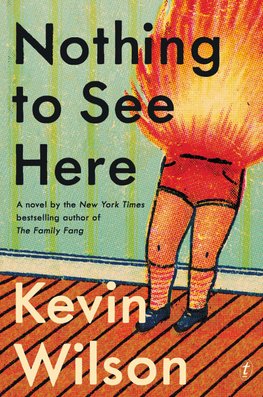
Nothing to See Here


Nothing To See Here by Kevin Wilson
By Kevin Wilson
Ecco     2019
272 pages     Literary

As I was reading Nothing to See Here by Kevin Wilson, I remembered  a time long ago, when one of my children threw such a bad fit at the grocery store that I had to haul him out of the grocery cart, leave all the groceries in the cart, and quickly exit the store in disgrace. Many of us have been there—but Bessie and Roland, the children of a soon-to-be US Secretary of State burst into flames when they get agitated. Wow! Now that’s a fit to which any child should aspire!

Madison calls upon her long-time friend Lillian in desperation. Her husband’s twin 10-year-olds are coming to live with them and she needs someone to care for them. Their mother has died, and they are going to  come to live on their father’s family estate in Tennessee. Jasper, Madison’s husband, is a senator and will soon be appointed Secretary of State. Bessie and Roland must be kept out of sight. Because, of course, no one can know that the children have this unbelievable “disability.” Madison, of course, doesn’t reveal this well-kept secret to Lillian, as she convinces her to come and take a nanny job on a short-term basis.

Lillian doesn’t have anything else going on in her life, and so she goes with Carl, the family’s caretaker to pick up the children. She very abruptly discovers why these children are to be housed in the guest house and hidden out of sight, and she quickly has to figure out what in the world to do with them. Lillian describes Carl as “a man who was really into watches,” which I found hugely amusing, although Carl definitely is not an “amusing” man. Thank goodness he is there, though, because as things evolve, Lillian ends up really needing his services and his problem solving skills.

There is so much to report about the book. It is extremely humorous, extremely honest, and earnestly sincere. Lillian is an incredible narrator. She is tough but extremely vulnerable with a remarkable understanding of herself and her place in the world. She is a wonderful foil for her great friend Madison, who has a similar sense of herself, but Madison is in a totally different place in the world—equally tough but also equally needy.

I became completely connected to the vulnerability of Bessie and Roland, children whose entire lives have been torn apart. They are so hungry for human attachment, and it is obvious that they are not going to receive any love from their father or step-mother.  They ask Lillian, for example, if they can sleep with her, and they wind themselves around her in the night—Roland with his finger in Lillian’s mouth. They are very afraid that they will be separated from her, and she becomes equally as attached to them.

I am always looking for stories that I have not read before, and this is definitely one of those. Wilson is a terrific storyteller, and the fairy-tale, slightly lunatic quality of the narration seems totally appropriate to the subject matter. He has you laughing one minute, and crying the next, celebrating the ways in which Lillian approaches the children’s needs and desires while at the same time worrying  about the possibility that  the children will lose their cool and burn the house down.

Taffy Brodesser-Akner, the reviewer in the New York Times felt much the same way. (By the way she is the author of Fleishman is in Trouble that I reviewed a couple of months ago.) She begins her review, “Good Lord, I can’t believe how good this book is.” And she closes her review thus: “Wilson writes with such a light touch that it seems fairly impossible for the book to have a big emotional payoff. But there is, and that’s the brilliance of the novel—that it distracts you with these weirdo characters and mesmerizing and funny sentences and then hits you in a way you didn’t see coming. You’re laughing so hard you don’t even realize that you’ve suddenly caught fire.”

Nothing to See Here is a book that you will want to sit down with and read all the way through in one sitting, just so you can absorb its brilliance, without any distractions.

Kevin Wilson is the author of several novels, including The Family Fang. Here is his website.


Sunday, September 8, 2019

Cornelius Sky


By Timothy Brandoff

Akashic Books     2019
224 pages     Literary

New York in 1974. Cornelius Sky (Connie) is a doorman in the building where a former First Lady and her son (think JFK Jr.) live. Connie hangs out with the teenage boy, tries to keep him safe from the prying eyes of the paparazzi, and offers him companionship and solace. Otherwise, Connie’s life is a mess.

He has estranged himself from his wife and his two young sons by his alcoholism, and finally his wife changes the locks, and Connie is out on the mean streets of the city—a city that seems to be falling apart right before his eyes. While he prides himself on his job and the great job he does buffing the marble floors, for example, he is haunted by his own past. This may be why he attaches himself to the fatherless boy and ignores his own sons.

Cornelius Sky is a superb character study, with vivid observations of Connie’s tumultuous life and the tumultuous city where he lives. Frankly, I loved Connie, in all his bruised glory. While I didn’t love the way he treated his family, I loved the way others saw the good in Connie and offered him redemption.

Most importantly, the author Timothy Brandoff is an astute observer of the human condition, and I found myself underlining entire passages of brilliant writing that moved my heart. For example, here is a description of the people in the bar Connie frequents:

“Longshoremen, mailmen, factory workers, auto mechanics, truck drivers, the unemployable, a couple of wet-brains, a misanthropic PhD or two hiding behind what they hoped people would consider academic beards of distinction, flabbergasted occupants of Chelsea’s swankier brownstones because their lives still somehow sucked despite impressive curriculum vitae and substantial earning power—all stood and drank at the bar together."

224 pages is a fairly short book but is an absolutely perfect length for Connie’s story. The Kirkus review concludes that “its detailed portrait of a self-destructive character retains a haunting power.” The reviewer is absolutely right about the “haunting power.” I read Cornelius Sky several weeks ago, and it has remained with me.

Timothy Brandoff has an interesting personal history. He wove together details from his own life as he created the character of Cornelius Sky.  He is a New York City bus driver and a former doorman, following the career path of his uncle and brother. He suggests, however, that while there are aspects of the book that follow his own life’s path, he hopes that the story is “true to itself.”

I hope that Brandoff will tell more stories of the characters he meets as he drives his bus through the city.

Wednesday, June 19, 2019

Where the Crawdads Sing


By Delia Owens

Putnam     2018
384 pages     Literary

Despite some implausibility, which my book club friends were happy to point out at book club last night, I absolutely loved Where the Crawdads Sing by Delia Owens. Primarily, I was entranced by the descriptions of the marshlands of the Outer Banks and how Kya Clark learned to live by herself and become an expert in the life of the marsh.

When Kya was a small child, her mother walked away from the shack in the North Carolina marsh where the family lives, unable to endure her abusive husband any longer. All the children leave as well, leaving Kya alone with her drunken father. When her father leaves for good, Kya must fend for herself. As she grows, she becomes a sort of mystical character to the residents of the small nearby village. Called “the marsh girl”, she successfully is able to fend off attempts to get her to go to school, get sent to an orphanage, or in any way become part of the community.

As much as Kya hides from society, she misses human contact. Tate, a brilliant young man of the village, becomes her primary contact with other humans. He loves the marsh as much as she does, and over several years, he teaches her to read and write and study the environment. Additionally, a black couple who run the convenience store and gas station become the people who seem to watch out for her the most and protect her.

The story-line weaves back and forth between Kya’s growing up in the 50s and early 60s and the death of a young man in the village. Chase has been Kya’s off- and-on lover, and after his apparent murder, Kya is accused of causing his death. The trial is absolutely breath-taking. I found myself having to pace my reading and my breathing. The climax of the book is equally heart-stopping.


The parts of the book where Kya learns to forage, to live off of nature, and observe everything around her are so beautifully and skillfully written that I became completely enmeshed in the imagery. I found myself underlining many passages beginning with the first paragraph. “The morning burned so August-hot, the marsh’s moist breath hung the oaks and pines with fog. The palmetto patches stood unusually quiet except for the low, slow flap of the heron’s wings lifting from the lagoon.” Or in an especially vivid description of the village, the author writes, “Mostly the village seemed tired of arguing with the elements, and simply sagged.” Can’t you just see it!

There are reasons why Where the Crawdads Sing has been at the top of the NY Times bestseller list for thirty weeks. Delia Owens spent many years as a nature researcher in Africa, so she can relate to the isolation of the wilderness, whether it be the Savannah or the marsh. In a very interesting interview, she mentions that she picked North Carolina as the setting for the novel because its temperate climate would allow for foraging all year. Owens has written several nonfiction books about Africa, but this is her first foray into fiction. Reese Witherspoon has picked up the rights. We’ll see what can be done to make it into a movie.

Friday, May 31, 2019

Deep Water Blues


By Fred Waitzkin

Open Road Media     2019
160 pages     Literary

It is always a lovely experience when you open a book with no anticipation, and then find that it matches your reading ideals. Such was the case with the novella, Deep Water Blues by Fred Waitzkin. It is the story of a paradise island in the Caribbean called Rum Cay that becomes paradise lost. It is the story of greed and misplaced expectations, love and lust, and great loss.  

While the author himself is a character in the book, the main character is an expat named Bobby Little who has created a small paradise on a remote island in the Caribbean. The boat dock, the restaurant where Bobby is the chef, and the entertainment are all courtesy of Bobby. But then, suddenly, things change. Tragedy strikes when a boat carrying Haitian migrants capsizes in the harbor, and the grisly shark-eaten bodies cast a pall over the island. Bobby struggles to regain his footing and becomes threatened by a business partner, Dennis, who conspires to take over Bobby’s kingdom.

What makes the story unique is the insertion of Fred Waitzkin, the author, into the story line as an observer to the plot. He acts as a quasi-narrator, although he is not in every scene. He is on his fishing boat, the Ebb Tide, with a couple of buddies and an artist, John Mitchell, whose drawings become an integral part of the book. He says, “Many times I’ve made the long ocean voyage to Rum Cay to troll off the southeast corner of the island. But my fishing ardor has often been dwarfed by surprises onshore, where breezy sensuous nights plunge me back into the yearnings of a younger man and where I’ve met maimed and beautiful people on the dock and a few that were evil beyond redemption.”

Somehow, Waitzkin’s addition of himself into the plot lends authenticity to the story. What is true? What isn’t? This is a great plot device and kept me reading through a lot of grisly stuff. What was going to happen next? How would it end?

Deep Water Blues is not a book I would have picked up to read on my own, which made the surprise of good writing and fascinating plot all the more desirable. Thanks to the publicist for introducing me to a a very interesting read.

 Fred Waitzkin is the author of the memoir, Searching for Bobby Fischer, which told the story of his son Josh, a child prodigy and chess expert. Many will remember the movie based on his book. This is his website.


Thursday, May 23, 2019

A Devil.Comes to Town


By Paolo Maurensig

Translated by Anne Milano Appel
World Editions     2019
120 pages     Literary

Well, for sure, I have never read this book before! Here is the brief description from the publisher.

“Everyone’s a writer in Dichtersruhe (Switzerland). The residents have one thing on their mind: literature. So when the devil turns up claiming to be a hot-shot publisher, unsatisfied authorial desires are unleashed, and the village’s former harmony is shattered. Taut with foreboding and Gothic suspense, Paolo Maurensig gives us a refined and engaging parable on narcissism, vainglory, and our inextinguishable thirst for stories.”

In only 120 pages, Maurensig weaves a story of ultimate menace and anxiety, layering detail upon detail with such skill that the reader is left breathless—when they are not smiling in amusement at the vanity of the residents of the village, and the scurrilous image of the devil.

Frankly, it took me a while to get into the story, and when I finally figured out what was going on, I had to go back and begin again with some AHA moments now more present in my mind. How easily the human psyche can be flattered! How easily the human mind can be convinced that it has something special to share with the world! How easily the human will can be led down the wrong path! As the narrator notes, “It is incomprehensible how people who are more than mature—the burgomaster, too, is by far over seventy—can behave like children lured by a stick of candy.”

Maurensig’s depiction of the devil in the guise of a publisher is spot on. “. . .everything about his person reeks of excess, his laugh is raucous, his gestures theatrical, his hair, slicked back and rather long and greasy, is dyed black; his lips are purple and thin, the corners turned up to mimic a perennial smile. . .and the voice, that voice. . .”

As I reread the devil’s description, I was remembering a time in my life when the devil came to town. I was seeking to manage the insurance money that came from my husband’s estate, when a young man came to town. He had impeccable credentials and was from a prominent Michigan family. He had a plan to expand a pizza empire, since his family was friends with the chain’s founder. A coworker introduced me (as well as several other  coworkers), and we all invested in his proposition—which turned out to be a devilish scheme. Chaos ensued when he skipped the country with all our money. Eventually, we had to hire a lawyer, and the family returned all our investments. How easily we were suckered in!

Vanity and money are two guiding principles for the devil. Maurensig tells his tale with no feelings left intact. We are all vulnerable. The Kirkus reviewer said it best, “In this very creepy novella, the award-winning Italian novelist Maurensig (Theory of Shadows, 2018, etc.) constructs a mystery with the structure of nesting dolls, folding story within story until it’s impossible to separate technique from narrative.” 

Sunday, January 20, 2019

Radiant Shimmering Light


By Sarah Selecky

Bloomsbury     2018
422 pages     Literary/Satire

Sarah Selecky’s debut novel, Radiant Shimmering Light, is a delicious send-up of the online self-care movement that aligns itself with social media and self-promotion. The book is extremely funny and extremely sad, all at the same time. Lilian Quick, age 40, is a self-absorbed, self-doubting animal-portrait artist. She lives in Toronto, has little money, but she does have a few good friends. Her major gift is that she sees the auras of the dogs she paints, including the auras in the backgrounds of her paintings much to the delight of the dog owners. She also has a penchant for taking Instagram photos of everything that happens to her and keeping a running Twitter feed going. Of course, this involves compulsive checking to see how many responses she gets to her posts. Her self-doubt extends into every moment of her life as well. Here is an example: “I hate winter. No! Replace that thought with something positive. . .On my way out, I take off a mitten and try a selfie again. My clothes look cute and hygge, but my face looks lopsided and I have bags under my eyes. I delete the pic.” She even took an Instagram picture of her finger after she cut herself, immediately checking to see how many people posted sympathy responses.

One of Lilian’s friends keeps a great blog that makes her look like her life is perfect; another friend is a successful realtor; and another goes by the name of Yumi but his/her preferred prefix is “they.” (This I particularly liked.) She also has a cousin named Florence Novak, who is a self-help guru, calling herself “Eleven.” After many years, Lilian and Eleven reconnect at a self-actualization rally that Eleven’s organization is sponsoring in Toronto. Following that event, Eleven convinces Lilian to attend her six-month empowerment program called “Ascendency” but also to come and work with her at her headquarters in New York. She promises that Lilian will become both empowered and wealthy as her online business takes off and she loses her self-doubt and gains power. After this setup, the novel proceeds to watch, among other things, Lilian’s ability to see the aura of dogs extend to the people around her. As a consequence, her business booms—but not so much her personal life.

As frustrated as I got with Lilian, I sympathized with her journey toward authentication. She is a very real character as are Eleven and the other women in the movement. I do have to say, as much fun as I had with Lilian’s journey with Eleven, I got a little bored. The book is perhaps 50 pages too long. One can only self-actualize for so long! The reviewer in the Minneapolis Star Tribune remarks: “Selecky masterfully mimics the marketing-speak of “gurus” like [the character] Eleven: an endless cycle of metaphor and hyperbole, pet names for her followers (“petals,” “darlings”) and a cultish adaptation of language for her own purposes.”

I was enamored with Radiant Shimmering Light from the very first pages. I saw people I knew in the self-actualization movement. I have a peripheral relationship with a woman who wishes to have a similar lifestyle guru status in the world and is on a tour right now to make her place in the movement. Every time I read about Eleven, I thought “I know this woman.” I also have a 7-year-old granddaughter who recently told me that she can tell how someone is feeling by just touching them. (Frankly, that freaked me out a bit.)

The Booklist reviewer suggests that the novel is “an insider look at the intersection between the sincerity of belief and the commodification of aspiration.” Selecky pokes fun at the culture of online empowerment that attracts women in particular — that strange mix of spirituality, philosophy and self-help with a healthy dash of capitalism — without mocking or dismissing it.” (From the Toronto Star review.)

I think Selecky did a marvelous job of understanding the female-empowerment movement and its online stimulus to create wealth. By the way, she probably used her own experiences as fodder for the novel; she runs an online writing school that “approaches writing as an art and also as a contemplative practice.”

Tuesday, September 25, 2018

French Exit


By Patrick deWitt

Ecco     2018
256 pages     Literary

Frances Price is a New York socialite with a adult son, Malcolm, who lives with her, and a family cat, Small Frank, who apparently is the spirit of Frances’ dead husband, Franklin. Frances is everything you could imagine a 65-year-old socialite to be: sharp-tongued, full of preconceptions, and mannerisms. She delights in “implied insults and needling insinuations.” As an example, Frances doesn’t like Malcolm’s fiancé because she once ordered gazpacho out of season.

A scandal has defined Frances through the years in New York society. She had returned home and found her husband Frank dead in bed. Instead of calling the police, Frances went skiing for the weekend—because there wasn’t anything to be done about it. Now, Frances has no one but her son and one friend, Joan. She also has just a limited amount of money and decides to sell her apartment and move to France to live in Joan’s Paris apartment.

A French exit, by the way, means to leave a social gathering without saying your farewells. And in the first, really funny scene, she does exactly that. However, for Frances, the meaning of French exit has a slightly sinister tone to it. She actually plans to exit herself once she gets to Paris. “Sometimes the world corrected itself, she knew this, for it had so many times in her past. She understood intuitively that it would not correct itself now, though.” In other words, Frances is bored with life and wants to make her own “French exit.”

Why Malcolm joins her in Paris is one of the unanswered questions in the book. Is he so spineless that he has to follow his mother around endlessly? And indeed he does, leaving behind a fiancée who is not sure why she loves him. Susan, Malcolm’s fiancée, wonders why she had “come to care for this lugubrious toddler of a man.”

Well, once they get to Paris, they collect a cadre of crazy people, including a psychic, who calls the presence of Frances’ husband from the cat, a private investigator, a doctor named Touche, and a great cook who feeds them souffles and cocktails. Friend Joan arrives at her apartment, and she is soon followed by Malcolm’s fiancée Susan and her new boyfriend. Chaos ensues. These scenes have been compared to a Noel Coward comedy of manners. French Exit may best be called a tragic comedy, because although there is always a comic turn to everything, we know from the very beginning tragedy is just around the corner. The NPR reviewer suggests that you can’t take anything too seriously, because if you do, the entire novel falls apart.

Frankly, once I got into the premise of French Exit, I enjoyed all of it. The New Yorker calls the novel “stealth absurdism.” It took me a bit to realize that was what I was reading, but when I figured it out, I settled in and just went along for the ride. Patrick deWitt has written books in several genres, but this is his first comedy of manners. Out now,  movie The Sisters Brothers is a slapstick Western starring inept outlaws. The movie is based on another of deWitt's novels. I really wanted to see the movie before I wrote the review of French Exit, but the movie hasn’t come to Kalamazoo yet.