Search

Showing posts with label Noir. Show all posts

Tuesday, September 12, 2023

A Darker Shade of Noir

Edited by Joyce Carol Oates


Akashic Books     2023

266 pages     Noir/Horror

Joyce Carol Oates has written a remarkable introduction to A Darker Shade of Noir, Akashic Books’ newest addition to their collections of Noir fiction. It really tells you everything you need to know about the book and its outstanding group of women authors, each of whom contributed a story to the collection, including Oates, Margaret Atwood, Tananarive Due, and Megan Abbott—authors that I knew about and had read before. The introduction can be found here.

 The stories in the collection tell every type of modern versions of female-related horror similar to the mythological figures whose names we know, such as Medusa, or the Salem witches. Each of the stories considers one type of female horror. For example, “Frank Jones” by Aimee Bender really captures your attention when she tells the story of a young woman with skin tags that she saves to horrifying results. The woman in the next story by Tananarive Due can’t stop dancing. She has been dancing ever since her grandmother died.

I think most women understand the idea of body horror in its more basic forms, as well as the history of the subjugation of women through the centuries. Joyce Carol Oates addresses this superbly in the written diary of a woman in a mental asylum in the mid-1800s. And, of course, there is the accounting by Margaret Atwood of a snail that invades a woman’s skull, her soul, and her psyche. Way creepy!

But I really got spooked by Megan Abbott’s story about a haunted house in Penny’s neighborhood. Apparently the doctor who owned the house killed his wife and children many years before. Through the years, neighborhood children told the story of the killing and the haunting. Young Penny decides to investigate one night to disastrous results. I remembered a big deserted house on the river in the small Minnesota town I lived in as a child. The really brave kids would run up the steps and knock on the door on Halloween. One Halloween,  I thought I saw a light in one of the upstairs rooms, and everyone ran out of that yard as fast as we could! I had a bad dream the night I read Abbott’s story!

I could go on and on. These are marvelous stories that touched a real nerve—in both my body and my mind. Highly recommended.                                                                                                                                                                                                                                                                                               

Thursday, August 3, 2023

Cleveland Noir

Edited by Michael Ruhlman and Miesha Wilson Headen


Akashic Books     2023

288 pages     Noir

When Akashic sent me Cleveland Noir to review, I noticed immediately that I had read books by Paula McLain and Thrity Umriger, both of whom had stories in this iteration of the noir genre and the great series that Akashic publishes. The book was published this week and is very much worth a read.

Apparently the city of Cleveland has had it’s share of real life noir, including Eliot Ness, who worked for a while as Cleveland’s Director of Public Safety, the disappearance of Beverly Potts that has been an unsolved crime for the last 60 years, and the murder of Marilyn Sheppard, which resulted in her husband Dr. Sam Sheppard being charged and subsequently acquitted for her murder. All of these brought crime in Cleveland to the nation’s attention.

The stories in Cleveland Noir have a lot going for them. Each story oozes atmosphere and compelling danger. The editors suggest: “ It’s this mix of the wealthy and the working class that makes the city—an urban center of brick and girders surrounded by verdant suburbs—a perfect backdrop for lawlessness.” They also suggest that these stories are love letters to their city and suburbs. I must also note that several of the stories take place or mention the lake and the beach, which, of course, is Lake Erie.

The first story in the book is by Paula McLain. In that story, two teenagers  enter into a “business” of robbing drunk people of their property, credit cards, whatever. My favorite sentence in the story is “We had accidentally landed on a planet where the air was to thin for guilt to populate.” Says a lot, doesn’t it!

I had to look up the facts related to Susan Petrone’s story, “The Silent Partner.” The story retells the story of Ray Chapman, a Cleveland Indians player who was killed by a pitch—the only major league player to ever die from an injury received during a major league game. Fifty years later, a reporter is exploring the death for an anniversary story and comes across information that seems to indicate that the incident wasn’t an accident. I’ll leave you to guess what happened as a result.


And the stories go on and on. I really enjoyed Cleveland Noir. Look up the Akashic Noir series of more than 100 books. If you are going on a trip, use the list as a guide to the underbelly of whichever city you are going to visit. You won’t be wasting your time, and you can find whatever crimes you might enjoy to explore.

Wednesday, June 7, 2023

Austin Noir

Edited By Hopeton Hay, Scott Montgomery, Molly Ordintz.


Akashic     2023

296 pages     Noir

I haven’t read any Noir for quite a while, so I was excited to pick up Austin Noir. I spent several days on a trip to Austin probably 15 years ago, so I was eager to see if my memories were represented in the stories in this volume. And indeed they were. Lady Bird Lake, where we attended a wedding (the reason for our trip), the bats under the Congress Avenue Bridge, as well as the downtown entertainment district are all in the book. Here are the stories:

*Part I - Crossfire
The pink monkey by Gabino Iglesias
Stunts by Ace Atkins
Reflections by Amanda Moore
The Good Neighbor by Jeff Abbott
A Thousand Bats on an Austin Night by Scott Montgomery
*Part II - Nothing I can do about it now
Rush Hour by Richard Z. Santos
Sapphire Blue by Alexandra Burt
Charles Bronson by Lee Thomas
Saving by Miriam Kuznets
A Time and Place by Jacob Grovey
*Part III
The Foundation by Chaitali Sen
Michael’s Perfect Penis by Molly Odintz
Stitches by Amy Gentry
Bangface vs. Cleaning Solutions, LLC by Andrew Hilbert

 I thought the stories represented the city well. I got a big kick out of “Michael’s Perfect Penis” by Molly Odintz, one of the book’s editors, although it is probably more a Neo-Noir story than actual noir. I enjoyed “A Thousand Bats on an Austin Night” by Scott Montgomery simply because I could visualize exactly where the story was taking place. And, of course, I had to read “Saving” by Miriam Kuznets, because she is named Miriam. It is a very good story. Oh, and by the way, lots of people will recognize the craziness of “Stitches” and the college scene as remembered by Amy Gentry. I was impressed that even at the darkest moments in the stories, the authors were still able to capture the vibrancy of the city of Austin.


I am always fascinated by what authors and publishers consider to be noir. And I know that readers feel that way as well. I wrote an essay for my site several years ago about Noir and Neo-Noir. It remains one of my most-read entries. Here it is.

Akashic has just sent me two noir books coming out this fall—one set in East Jerusalem and the other set in West Jerusalem. Look for my reviews later. I just love this series. Anywhere you want to visit, check out the noir versions of the city before you go. There’s a book for that!

Monday, June 6, 2022

May God Forgive

 By Alan Parks

Europa Editions     2022

371 pages     Noir

If you ever wanted to know what classic Noir is, this series of books by Alan Parks is the place to begin. May God Forgive is the fifth book in the series, which begins with Bloody January, published in 2017. Although this was the first of the series that I read, I didn’t have much trouble getting acquainted with Detective Harry McCoy. McCoy has returned to the Glasgow police force following a month off to recover from a bad ulcer attack. However, just as he returns, the city is racked by several unforgiveable crimes. Here is a brief synopsis of the book:

“Glasgow is a city in mourning. An arson attack on a hairdresser’s has left five dead. Tempers are frayed and sentiments running high. When three youths are charged, the city goes wild. A crowd gathers outside the courthouse, but as the police drive the young men to prison, the van is rammed by a truck, and the boys are grabbed and bundled into a car. The next day, the body of one of them is dumped in the city centre. A note has been sent to the newspaper: one down; two to go. Detective Harry McCoy has twenty-four hours to find the kidnapped boys before they all turn up dead, it is going to mean taking down some of Glasgow’s most powerful people to do it.”

May God Forgive takes place in Glasgow in the spring of 1974. The city is really gritty and crime filled, and McCoy knows the city and all its criminals really well, hence his need for Pepto Bismol night and day. We, the readers, try to keep up with his logic as he sets out to solve both the fire at the hairdresser’s and the young men’s murders. He has the additional crime of a young woman’s murder, and the knowledge that she appeared in a photograph with one of the young men. Oh, and I almost forgot, he has to solve the murder of a homeless man that he knows from his detective work. And this is to say nothing about the brief appearance of his estranged father, who haunts his memory night and day. There are many characters in the novel, some making very small appearances, and several others who seem to have long-term relationships with McCoy, who grew up in the city. A couple of times, I found myself at a bit of a loss to remember which character was which.

The city of Glasgow is very much a character in the novel, and I enjoyed reading about the city and its inhabitants, including the crooked Archbishop as well as all the shop and bar owners. Luckily, I had a British son-in-law visiting as I read the book, so if I ran across a word or a concept I didn’t understand, I could ask Stuart for an American definition. For instance, I was confused by the word “jumper” and Stuart said a jumper was a sweater. Aah!

Did I mention that it is raining nearly every day as McCoy checks in with all his sources, meeting many of them in neighborhood bars, drinking and smoking his way to a solution to the crime. It reminded me that if I ever get to Glasgow, I shouldn’t visit in May.


As my readers know, I am fascinated with noir and neo-noir. Here is an entry I made several years ago as I tried to describe what makes noir identifiable as a genre. May God Forgive is the epitome of the genre. The reviewer in the Times of London said, “McCoy is so noir he makes most other Scottish cops seem light gray.”

Alan Parks has had a career as a music producer, and readers can get a sense of his love of music with the background music that shows the atmosphere of 1970s music. Park’s Harry McCoy mysteries have been nominated twice for well-deserved Edgar Awards. Classic Noir indeed!

Monday, May 23, 2022

Denver Noir

 Cynthia Swanson, Editor


Akashic     2022

264 pages     Noir

Denver Noir is this spring’s offering from Akashic Books and their marvelous Noir series. There are over 100 books in this series, each one set in a major city in the world, each one featuring a local set of authors, and each one with a different take on the concept of noir. The Oprah Magazine says, “Each volume in the series reveals a city’s distinctive inner darkness.”

One of the fascinating aspects of Denver Noir is the diversity of the story authors and the diversity of the characters—as diverse as the city itself. The noir-ness (is that a word?) is also very diverse. There is a Native attorney and a female private investigator. There are crime-ridden streets and wealthy neighborhoods. There is beautiful scenery and scrubby apartments above taquerias. There is history and there is gentrification. My favorite story was “On Grasmere Lake” by Mathangi Subramanian, about a young woman college student and an unsolved murder.

The editor, Cynthia Swanson gives a remarkably good introduction, and says that working with these authors has been one of the highlights of her career. Although all of the story authors have all been published beyond Denver Noir, this book was my introduction to their talent.

 This is a great collection of stories, and Swanson has done an excellent job introducing Noir readers to the neighborhoods of Denver, a city I visited many years ago. It is a fun, diverse, and immersive read.

Wednesday, February 2, 2022

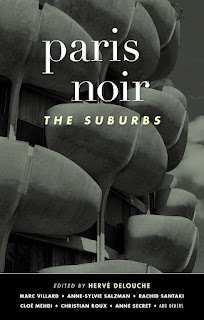
Paris Noir: The Suburbs

 Edited by Hervé DeLouche


Akashic     2022

280 pages           Noir

Why did the Baroness engage in the drug trade? “I wanted to spice up my life.” 

Why do I read noir fiction, especially the noir that comes from the Akashic Noir Series? Because I want to spice up my life! I am not sure, however, that this particular iteration of the series, Paris Noir: The Suburbs, will spice up life too much. Dirty, gritty, and crime-laden, indeed the stories are that, but I was disappointed that they were not very intriguing or immersive. Not even the story about the Baroness. Having just read and reviewed Palm Springs Noir, which I really enjoyed, I was a bit disappointed. 

The editor says that the goal of the book “was to depict the Parisian suburbs in all their plurality and diversity.” Thus, the editor elected to let the authors pick the suburb they wanted to depict in the story each had in mind. The stories in these settings are not the cozy neighborhoods Americans connect with the term “suburb”, but factory sites, run-down apartments, and neighborhood dives. The editor says, “When the suburbs are dumping grounds for the excluded, they breed insulted and rebellious individuals.” Many of the characters in the stories are just that—few are appealing at all.

It was hard to get involved in the thirteen stories in the anthology. If you want to delve into the Akashic Noir series, I would not start with Paris Noir: The Suburbs. The Publishers Weekly reviewer suggests that “this entry in this acclaimed series is only average at best.”

I am moving on to Denver Noir, which will be coming out soon. At least, the scenery there is beautiful.


Tuesday, January 11, 2022

Harlem Shuffle

 By Colson Whitehead


Doubleday     2021

336 pages     Thriller/Noir

Where to start? First of all: an apology. I had not read either of Whitehead’s Pulitzer Prize-winning novels, The Underground Railroad or Nickel Boys when I began Harlem Shuffle. And I can’t believe my ignorance of such an incredible author! I started the year with probably the most engaging book I will read all year.

Here is the brief synopsis from the Amazon website. “Colson Whitehead’s latest is a blisteringly entertaining novel of schemers and dreamers, mobsters and crooks, elaborate heists and furniture fronts, and the thrilling mischief of those who are up to no good and others who are just trying to make a living. Caught between his family’s penchant for shady deals and his desire to be clean, Ray Carney sits at the center of this swirling drama set in 1960s Harlem. A tribute to the city, the momentum of life, and the duality that lies in each of us, Harlem Shuffle is a lot of fun to read and another great offering by two-time Pulitzer Prize winning author Colson Whitehead

Ray Carney is a marvelously-developed character. The moral dilemma he presents is so real, so present that the reader almost forgets that the book takes place in the 1960s. Except the 1960s are ever present in the background of the plot: the protests, the gentrification of New York City, the development of the World Trade Center. The marvelous review in The Atlantic comments on this:

“In the moral universe of Harlem Shuffle, the honest in honest work is literal. The novel privileges the perspectives of its avowed criminals—thieves, mobsters, and prostitutes, all candid about the nature of their profession—over those who have convinced themselves that their dubious machinations are ethical, which is to say bankers, real-estate developers, and the suits who work to find them loopholes.” 

I think the thing that impressed and amazed me the most is the density, creativity, and the brilliance of the writing. I found myself laughing at many of the comments of the characters or the description of a particular setting. Here is one description of Ray Carney’s career. “An outside observer might get the idea that Carney trafficked quite frequently in stolen goods, but that’s not how he saw it. There was a natural flow of goods in and out and through people’s lives, from here to there, a churn of property, and Ray Carney facilitated that churn. As a middleman. Legit.” Or the description of a waitress:  “Certainly she hadn’t quit show business, waitressing being a line of work where you had to play to even the cheapest of seats.” Whitehead describes Times Square around midnight as an” incandescent, stupefying bazaar.”

This is not your typical noir fiction because the subject is far more universal than that. Today, for instance, I greeted two acquaintances who are honest in the same way Ray and his buddies are honest—they are just trying to make a buck, feed their families, and put gas in their cars. If, on occasion, they deal in questionable behavior, well, it is all part of the gig. I recognized the characters Ray and Pepper and Freddy and Linus in the Kalamazoo characters Walt and Lawrence and Ken who call me looking for work. Vox calls Harlem Shuffle a morality play. It is indeed.

On the other hand, I found it a difficult book to get through, in part, because of the number of characters to keep track of and also because I wanted to savor every word. I’d start each reading thinking to myself, “Where was I?” I absorbed the history of New York City in the brilliant way Whitehead presented that history in the same way the citizens of Harlem and the rest of the city absorbed the history—the good, the bad, and the ugly!

I think anyone who wants to read brilliant fiction should read Harlem Shuffle, but be prepared to devote your heart and soul into the book—and also a lot of time. Harlem Shuffle demands everything you’ve got!

Wednesday, December 15, 2021

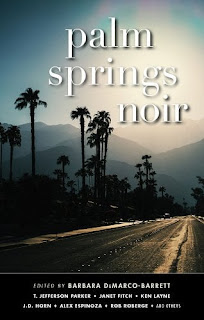
Palm Springs Noir

 Edited by Barbara DeMarco-Barrett


Akashic     2021

293 pages     Noir

I was at loose ends on Monday after a busy holiday prep weekend. I picked up Palm Springs Noir, knowing  that I would be entertained and enlightened about a city that I had been to several years ago. What I remembered best about the Palm Springs experience were the fields of wind turbines in the valley. Those wind turbines show up frequently in the short stories in the book, but apparently I didn’t have the same kind of Palm Springs experience that the characters in these stories had. I may have to go back.

In her introduction, DeMarco-Barret defines noir thus: “In noir, the main characters might want their lives to improve and may have high aspirations and goals, but they keep making bad choices and things go from bad to worse.” She goes on: “In noir, characters follow the highway to doom and destruction. They are haunted by the past, and the line between black and white, right and wrong, dissolves like sugar in water. The hero rationalizes why it’s ok to do whatever dark thing they are about to do.”

DeMarco-Barrett used that definition as she selected the stories to go into this volume of noir. The stories are just as sleezy as you might expect in a book of noir fiction, but the reader also experiences a lot of suspense and darkness. There are references to famous stars that have lived in the area and includes the music of Frank Sinatra and Elvis Presley. Through the stories we visit the places the tourist knows, like the golf courses and the pools, the mountains and the desert. My favorite place, Joshua Tree, however is spoiled by homicide, and a beautiful pool by a drowning. DeMarco-Barrett’s story concerns a brother who drowned in a mother’s pool. Could the sister have caused the drowning?

There are fourteen stories by several well-known Southern California authors. They are pure naughtiness happening in one of America’s most beautiful places. As steamy as the air. A great review in the NY Journal of Books.

I have written extensively over the years about the Akashic series of more than 100 noir books in settings all over the world. You might also like to read my description of noir and neo-noir literature. You can find it here. Stay tuned for the February arrival of Paris Noir: The Suburbs, which I will review the next time I have a day of loose ends.

Friday, January 15, 2021

Accra Noir


Edited by Nana-Ama Danquah


Akashic Books    2020

256 pages     Noir

Well, dear readers, you already know how much I love this noir series of books published by Akashic. I stepped out of my comfort zone to read Accra Noir, because, frankly, I am embarrassed to say that I had no idea where Ghana was on the map of Africa, let alone try to find Accra on a map. In case you are having trouble with your map skills, here are a couple of maps to help.


The primary theme of Accra Noir is money—and all the things the people of the capital city have to do to make a buck. Money is the essential component of each story. As one narrator says, “he was nothing there without money, nobody was. Not even the air of ancient entitlement that he wore held meaning. The one and only thing that held meaning anymore was money.”

I believe that each author had  the true intent of noir in the composition of their stories, and there is a lot of cruelty and murder among the stories. My favorite story involved a dead lover and the butcher in the neighboring market stall. Several of the stories discuss the plight of the women of Accra, and just perhaps, their ideas of vengeance. The Publisher’s Weekly review says that Accra Noir is one of the better Akashic anthologies.

Nana-Ama Danquah, the book’s editor, is a well-known author living in the United States. All the authors in the anthology have an intimate relationship with Accra and its stories. That relationship really adds authenticity to the reader. She says, “Everything in the culture revolves around story, and every story has a moral or theme, one that can be encapsulated in a pithy phrase.” These stories all bear witness to that tradition.

Frankly, I was blown away by these stories, and would encourage lovers of noir fiction to try these out. They are gritty enough to fill your noir needs. I have several new Akashic noir books on my Kindle, and I can’t wait to dig into them. Watch this space.


Thursday, September 10, 2020

Addis Ababa Noir

 Edited by Maaza Mengiste

Akashic     2020

256 pages    Noir

We have always rented our small basement apartment to graduate students, and it was our great good fortune to have Samson and his wife Nofkote as renters for two years. Samson had come to Western Michigan University from Addis Ababa to pursue a Master’s Degree. During the civil war, Nofkote had fled to the United States from Ethiopia with her family while Samson’s family had retreated to a rural area of Ethiopia.  Both were members of the same tribe—a tribe that had fallen out of favor during the civil war. Both fathers had been government officials. Samson’s father became a carpenter and Nofkote’s father drove a taxi in Washington DC.

 I learned so much from them. After graduation, they moved back to the DC area, where there is a very large Ethiopian community. Four years ago we were invited to Samson’s sister’s wedding in Detroit. We met Ethiopian doctors, lawyers, and professors, all of whom had come to the United States from Addis Ababa during the diaspora. It was an extraordinary experience to meet them and to hear their harrowing stories.

So, it was with this background, I absorbed the stories in Addis Ababa Noir. The stories are beautifully written and express the highs and lows of this incredible city—a city that has suffered greatly and a people that have suffered along with their city. Some of the authors have moved to other parts of the world and write about the Addis Ababa of their memory, either before or during the Red Terror. Some of the authors live there today. All have so much to tell us.

Like most of the Akashic Noir series, the fourteen stories in the collection run the gamut of the genre. Few can be called pure Noir, but all are haunting and describe a longing for better days and more peaceful times. I was particularly taken by the story of a young woman who returns to the city to bury a beloved aunt, only to find her previously unknown father and some startling details about her mother’s death. Another remarkable story concerns a small child who daily watches the ostriches as they wander the palace yard, but then one day she is sure she sees a dead body on the sidewalk in front of the palace, right by the bump in the road. In another, an old man tells a stranger a story about a woman he saw on the street. He was sure she was the girl he had known in school and fallen in love with. And then, tragedy strikes.  


Knowing what I already knew about the Ethiopian diaspora, the stories held a unique fascination for me. Maaza Mengiste, the editor, says in the introduction, “What marks life in Addis Ababa are the starkly different realities coexisting in one place. It's a growing city taking shape beneath the fraught weight of history, myth, and memory. It is a heady mix. It can also be disorienting, and it is in this space that the stories of Addis Ababa Noir reside.”

These are the stories of a people, who have faced disaster head on and have arisen tough and  resilient. Adddis Ababa Noir is as remarkable a collection as the people who populate it.

Here is a sample from the introduction of the book.

Monday, August 17, 2020

Berkeley Noir


Edited by Jerry Thompson & Owen Hill

Akashic     2020

242 pages     Noir

Isn’t Berkeley a nice city, full of wonderful, young, progressive college students? I always thought so, but not so fast. Berkeley Noir exposes the underbelly of this idealized city. As the editors’ say, “Where’s the noir in that perfect view of the Golden Gate, cutting-edge lettuces served in a ghetto dubbed ‘gourmet,’ the parking lot with reserved spaces for Nobel Laureates?” “Grifters? Dames? Cops? In Berkeley?”

There are sixteen stories in Berkeley Noir, but very few of them follow classic “Noir” patterns. One that does is The Law of Local Karma by Susan Dunlap. It is a cop drama with a body, a perp, some cops, and an unsolvable case. Lucky Day by Thomas Burchfield is a neo noir story about a worker at the Berkeley Public Library.

A favorite story is The Tangy Brine of Dark Night by Lucy Jane Bledsoe. In it, a young woman goes out into San Francisco Bay to bury her grandma. She is stopped by the police on the way, with a kayak sticking out of trunk and a dead grandma strapped into the front seat. Another brief but great story is Barroom Butterfly by Barry Gifford in which Roy’s grandfather introduces him to noir fiction. The review in Publisher’s Weekly notes that “Readers will be glad that many of these tales are fun in a way that traditional noir isn’t.” The editor of the book, Jerry Thompson says, “There are no happy endings in noir.”

As you know, I enjoy Akashic’s Noir series. I am currently reading Addis Ababa Noir and Tampa Bay Noir, and will report on them later this week. Join me in some great short stories.

A video interview with Jerry Thompson and Owen Hill.

Saturday, March 28, 2020

The Familiar Dark


By Amy Engel


Dutton     2020
245 pages     Noir

Just when I thought I could settle down a little and read something fun, I picked up The Familiar Dark to read and review. Incredible book but very shocking and unnerving. One reviewer called it rural noir, and it most definitely is that. I kept thinking about Once Upon a River and Mothers, Tell Your Daughters by Bonnie Jo Campbell and Hillbilly Elegy by J.D. Vance. If anything The Familiar Dark is grittier than these other tales, both fictional and autobiographical.

Amy Engel’s setting is small town Missouri in the middle of the Ozark mountains. Eve is a 30-something single mother of a 12-year-old, Junie. She is a waitress in the local diner. The opening scene really grabs your attention when Junie and her best friend, Izzy, are discovered murdered at the neighborhood playground. Who would kill two pre-teen girls? While the narrative is third party, the story is told completely from the perspective of the devastated and grieving Eve. She sets out to take revenge on whoever killed the girls.

When the back story emerges, we find that Eve and her brother Cal raised themselves. Their mother is a rather stereotypical trailer-trash character, drinking, smoking, selling and using meth. One reviewer called the mother, a “pit bull.” Most of Eve’s inner dialogue is concerned with her relationship with her mother and her brother, who has become a local police officer. Much of her anxiety stems from her inability to escape her past and the corrosiveness of the community in which she was raised. She thought that by being a good mother, she could help Junie escape. The major question of the novel is “Can anyone escape their background? The way they were mothered?”

For several years, I lived with my family in small town Michigan. The village was just as small as the village where Eve, Cal and Junie were raised, but because it was on a major highway, it was much more open to the wider world. At the same time, it was very confining. I remember the exact moment that I realized that this atmosphere was much too small and confining for my children. I saw that our children were not going to have as much intellectual stimulation as we wanted, and I convinced my husband, who had been raised in a rural environment, that we had to move for our children’s sake. The benefit of small town living is that everyone knows you; this also serves as the major weakness. This dynamic plays out well in Engel’s village.

The Library Journal reviewer says, “Not just a fine thriller but a fine character study, plumbing family and particularly mother-daughter relationships and showing Eve, her mother, and Izzie’s mother, too, as women unbendable as oak.” I could really relate to this analysis, because The Familiar Dark, in many ways, moves beyond noir to explore the depths of relationships. It is a worthwhile read under any circumstances, and if you can find a warm, restful spot in the midst of a pandemic, an excellent addition to your library. It will be released next week.

By the way, once I read the book, I really appreciated the title. Sometimes we embrace the dark (whatever the “dark” is) because it is something we know. Sometimes it is better than stepping out into the light. Here is Amy Engel’s website.

Saturday, February 29, 2020

Columbus Noir


Edited by Andrew Welsh-Huggins

Akashic Books     2020
284 pages     Noir/Short Stories

Columbus, Ohio, is a city that I know fairly well. My son, his wife, and my grandchildren lived there for several years when the children were young, and I currently have a niece and a nephew who live there, as well. So, the neighborhoods are familiar to me—especially German Village, which houses The Book Loft, one of the largest independent bookstores in the country.

Thus, I approached Columbus Noir, the new edition of the Akashic’s noir series with anticipation. The introduction was very appealing. The book’s editor is a journalist and author, and I really enjoyed his introduction to the idea of the ordinariness of Columbus, a concept that apparently no longer exists. He says, “Those who consider the old Columbus a comfy couch conveniently ignore the guns and knives that were hidden under the pillows.”

The collection contains 14 stories from 14 authors, including Welsh-Huggins. While the stories range in both content and quality, the most common aspects are sex and greed. Of course, some of the stories take place at Ohio State University, the pride of the state and the arch nemesis of the University of Michigan. Two of the stories introduce the reader to The Satin Fox, which must be a notorious strip club.

A story by Daniel Best is a great introduction to the well-known Short North neighborhood, and Welsh-Huggins story concerns the governor and his security guard/driver. The governor is on the short list to be Vice President, and his philandering must be covered up. A great story, by the way.

There is a very good interview with Welsh-Huggins in the Columbus Monthly. About Columbus as a setting for noir fiction, Welsh-Huggins says, Columbus is the perfect noir package. On the ‘good’ side we have iconic neighborhoods, a diverse population, a strong economy and all our foodie and arts and fashion trend-setting. On the ‘bad’ side we struggle with opioids, street violence and political corruption. To top it off, we have a chip on our shoulders after decades of being looked down upon as ‘Cowtown,’ which sometimes makes us overeager to reach for the stars, with all the light and dark consequences of such striving.

It's been my pleasure to review several of the Akashic Noir books over the past couple of years, and I have several more coming up. I like them because I am so curious as to the variety of interpretations of the term “noir, “ the variety of settings, and the vast numbers of authors who have contributed.
Here are some of my reviews: Montana Noir, Nairobi Noir, Vancouver Noir, Milwaukee Noir.

Tuesday, February 4, 2020

Nairobi Noir


Edited by Peter Kimani

Akashic Books     2020
256 pages     Noir Short Stories

The newest Noir short story collection by Akashic Books is published today. Nairobi Noir has three parts: The Hunters, The Hunted, the Herders. Each story in each section takes place in a unique area of the city. 

Kimani is quite a well-known African author, who obviously knows Nairobi intimately, and after I read his story “Blood Sister,” I realized that he was the perfect person to edit the book.

The introduction to Nairobi Noir is especially impressive. Kimani calls it “Concrete Jungle.” He says that in Nairobi, “traffic jams are so bad, even lions come out of the wild to marvel at the snarl-ups. This is no exaggeration; Nairobi is the only city with a game park, and the kings of the wild occasionally stray on major city highways to kill boredom. . .” It is one of the most unequal cities in the world, and the stories in the collection expose that huge inequality.

The first story is called “She Dug Two Graves” by Winfred Kiunga, and it is absolutely heartbreaking in its rawness. A young man in the Muslim neighborhood is killed, and his sister, Fawzia, is heartbroken. Somali refugees, the two young adults had shared a home, and Fawzia had helped to raise her brother. Ahmed was just one less Somali Muslim that the Nairobi police have to deal with, but there are a group of terrorists, with revenge on their hearts, who seek to enlist Fawzia to their cause. The results are painful to read as Fawzia seeks vengeance on the deputy Police Commissioner.

The ending of the story “Number Sita” by Kevin Mwachiro is particularly poignant, when the lives of some young men living communally are saved from the police by a group of women who place their bodies over the prostrate bodies of their sons and neighbors.

On the other hand, the story by Kimani called “Blood Sister” is a delight. Bobo, or Bob, is a swaggery young guy in the hood neighborhood called Karen. The reader can instantly recognize the type. Told in the first person, we see how Bobo goes about impressing the neighborhood and impressing the outsiders who come to document the activities of the neighborhood. Two women, one old and one young, are sufficiently impressed with Bobo that they call upon him to help with their efforts. The older woman is up front with what she needs from him, while the young woman hides her purposes. Is the story traditional noir? Probably not, but it is a fascinating story.

Nairobi Noir follows the highly successful Akashic formula, which focuses on one city per book. I have read and loved several previous books, including Montana Noir, Vancouver Noir, Lagos Noir, and Milwaukee Noir. To show you the quality of the stories in the Noir series, one story “There’s a Riot Goin’ On” from the Milwaukee Noir collection just won a special recognition from the Edgar Awards for 2020. I have five more books on my pile, Tampa Bay Noir, Alabama Noir, Berkley Noir, Columbus Noir and Santa Fe Noir. Can’t wait to delve into all of them.


Thursday, October 31, 2019

Fire Trap


By Bob Kroll

ECW Press     2019
296 pages     Noir

T.J. Peterson is an ex-cop suffering from PTSD and depression. Apparently, some of the details of his fall happened in earlier books, since Fire Trap is the third book in the series. (The other books include The Drop Zone and The Hell of it All.) At any rate, the reader can glean that he lost his job after a shooting, his wife has died, his daughter is a druggie, and he and his girlfriend have reached an impasse. In the conclusion to the series, his daughter and her childhood friend are both missing, but Peterson keeps getting messages indicating that the young women are pawns in a game targeting Peterson. He springs into action to try to rescue both girls and solve a series of killings.

Peterson suffers numerous flashbacks as he searches for the women, interviews numerous sleezy characters, and uncovers the dark web of porn in his hometown of Halifax. Sometimes, the reader needs to keep a list of characters, so wide is the range of people and places Peterson investigates. One reviewer mentioned that the book would make more sense if it was read in one sitting—so intricate and involved is the book’s structure. When I finally decided I was going to finish the book and sat down to get through it, I was able to appreciate Peterson and his life situation. For example, his counselor tries to comfort him: “Life plays tricks on us, Peterson. It lines the road with obstacles. Some are more difficult than others to climb over. We never sought to bury the circumstances of your life, but to reconcile them with the torment inside your head.” About three-quarters of the way through, the plot starts to move quickly and becomes a page-turner.

The dark procedural takes place in Halifax Nova Scotia, a place I have never visited and thought I could visit by reading Fire Trap. I had met a couple from Halifax on my recent trip to Vietnam, and they convinced me to come and visit their town. Uh huh! Fire Trap was definitely not the Halifax I want to visit. Atlantic Books Today, a Canadian review site muses: “No city can possibly claim to be perfect and doubtless the municipality of Halifax, Nova Scotia is no exception. Despite its reputation as being a beautiful and outwardly friendly place to visit, Halifax cannot possibly be as idyllic a destination as tourism commercials would have us believe. Yet you’d be hard-pressed to find a depiction of a major Canadian city as unremittingly bleak as the metropolitan nightmare author Bob Kroll makes of Halifax.

Bob Kroll is a career-long author. It seems wise to me that he decided to make this only a trilogy. How much more could one ex-cop suffer? Publisher’s Weekly suggests that Fire Trap is a morality tale “strictly for serious fans,” and I would concur. I am not sure that I would have completed it were it not that it had been sent to me by the publisher.


Saturday, May 11, 2019

Milwaukee Noir


Tim Hennessy, Editor

Akashic     2019
291 pages     Noir

I am constantly enthralled by the way authors and editors define noir fiction, and the new book, Milwaukee Noir, which came out this week, continues to redefine the style of writing that can be considered “noir.” This collection is unique, just like the stories in all the other collections from Akashic.

The editor, Tim Hennessy, is a book seller and writer. His introduction to the book also appeared in the website Crime Reads. It appeared earlier this week on the site the day the book came out. He mentions that society doesn’t think much of Milwaukee, but he goes on to elaborate all the literary figures who have lived or died, as the case may be, in the city. Of Milwaukee he notes:

“Presently, Milwaukee is going through a renaissance—abandoned factories being converted to condos, craft breweries and distilleries pushing out corner taverns—yet at the same time it is among the most segregated and impoverished big cities in the country. The gentrification of neighborhoods outside of the downtown bear the impact of twentieth-century redlining efforts, forcing residents out due to housing demand, adding fuel to the affordable-housing crisis. Such an environment and atmosphere make excellent fodder for noir fiction—an outlook out of step with the romanticized nostalgia that Happy Days and Laverne and Shirley created of Milwaukee.”

The collection had my attention with the first name on the cover, Jane Hamilton. Her book, The Excellent Lombards, was my favorite fiction book of 2016. Her entry, Friendship, is the tale of what happens when three New York friends journey to Milwaukee to visit their friend, Sally John, who has moved to this strange midwestern city. Hamilton incorporates much of the city in the story, including the marvelous art museum right on the lake. Hamilton speaks to this: “What city would commission Santiago Calatrava to design their art museum, a city with a gorgeous body of water as backdrop, and blot it out in the approach with a third-rate heap of orange-painted steel I-beams!” She is a marvelous writer and the story, while perhaps a stretch to call it noir, doesn’t disappoint.

One of my favorite stories is by Larry Watson called Night Clerk. This is more traditional noir, as is Summerfest ’76 by Reed Farrel Coleman. My favorite line about Milwaukee is in Coleman’s story:    “. . .all I ever saw out of Lisa’s window was grayness. Oh, that’s not totally fair. It was grayness interrupted every other day by lake-effect snow.” (Lake-effect snow is the bane of the existence of any one who lives on the Lake Michigan shoreline.)
   Houston Noir is the other new addition to Akashic’s noir collection. Hope to read it next week.


Monday, February 4, 2019

Bellini and the Sphinx


By Tony Bellotto

Trans. by Clifford E. Landers
Akashic    2019
270 pages     Hard Boiled

Tony Bellotto is a well-known Brazilian author, guitarist, song-writer, and commentator. Bellini and the Sphinx is the first of his series of hard-boiled detective fiction featuring Remo Bellini. It was published in Brazilian Portuguese more than 20 years ago and made into a Portuguese language film in 2002. Bellini is making his debut in an English translation this week.

Bellini is a classic private eye, having fallen into the career from a failed attempt at the law. He works for a woman PI, Dora Lobo, and generally does run-of-the-mill cases like adultery. In this particular case, the firm has been hired by a local doctor to find a missing dancer, Ana Cinta Lopes. But then the doctor turns up murdered. What is going on here? Why doesn’t anyone know Ana? Who is the hulking live-sex performer known as the Indian? What role does he play in the whole mess? Little by little the mystery unravels these questions, leaving both Bellini and the reader with answers but no satisfaction at its conclusion.

Although the case itself is rather mundane, the reader is exposed to the underbelly of the city of Sao Paulo. Also to the bruised psyche of Remo Bellini. Of course, most hard-boiled detective stories expose the bruised psyches of the detective. The reviewer in Publisher’s Weekly says that the book “starts off strong but falls flat in its overly familiar execution.” If a reader were interested in knowing what hard-boiled detective fiction is all about, this would be a good place to start. Bellini chases women, drinks too much, and listens to the blues—all classic PI behaviors.

Here are some things I did like about the book. The theme is expressed in the early pages by a club manager, Khalid. “Take it from me, women are an illusion. Women are like champagne; they seem real but they only exist as long as there’s music in the air.” That theme is repeated again and again throughout the book. Another thing I found appealing was the musical play list that Bellini soothed himself with throughout the book. I had Alexa play Muddy Waters, John Lee Hooker, and Charlie Patton as I read. Really helped to set the scene. I like the references to Greek and Roman mythology—a fun addition to the story. Finally, I liked the Sao Paulo setting because, most likely, I am not going to get to Brazil and certainly not to the part of Sao Paulo that Bellini frequents.

Tony Belloto is also the editor of two of Akashic’s Noir books—Sao Paulo Noir and Rio Noir. I enjoy these books a lot because each setting brings an entirely new look at a city as well as a new understanding of Noir fiction in its many varieties. I am assuming that more of the Bellini mysteries will be published by the company. I looked for a way to access the 2002 movie, Bellini e a Esfinge, and I did find it in Portuguese on YouTube. The music is amazing.