Search

Showing posts with label short stories. Show all posts

Wednesday, December 15, 2021

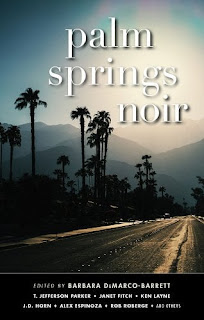
Palm Springs Noir

 Edited by Barbara DeMarco-Barrett


Akashic     2021

293 pages     Noir

I was at loose ends on Monday after a busy holiday prep weekend. I picked up Palm Springs Noir, knowing  that I would be entertained and enlightened about a city that I had been to several years ago. What I remembered best about the Palm Springs experience were the fields of wind turbines in the valley. Those wind turbines show up frequently in the short stories in the book, but apparently I didn’t have the same kind of Palm Springs experience that the characters in these stories had. I may have to go back.

In her introduction, DeMarco-Barret defines noir thus: “In noir, the main characters might want their lives to improve and may have high aspirations and goals, but they keep making bad choices and things go from bad to worse.” She goes on: “In noir, characters follow the highway to doom and destruction. They are haunted by the past, and the line between black and white, right and wrong, dissolves like sugar in water. The hero rationalizes why it’s ok to do whatever dark thing they are about to do.”

DeMarco-Barrett used that definition as she selected the stories to go into this volume of noir. The stories are just as sleezy as you might expect in a book of noir fiction, but the reader also experiences a lot of suspense and darkness. There are references to famous stars that have lived in the area and includes the music of Frank Sinatra and Elvis Presley. Through the stories we visit the places the tourist knows, like the golf courses and the pools, the mountains and the desert. My favorite place, Joshua Tree, however is spoiled by homicide, and a beautiful pool by a drowning. DeMarco-Barrett’s story concerns a brother who drowned in a mother’s pool. Could the sister have caused the drowning?

There are fourteen stories by several well-known Southern California authors. They are pure naughtiness happening in one of America’s most beautiful places. As steamy as the air. A great review in the NY Journal of Books.

I have written extensively over the years about the Akashic series of more than 100 noir books in settings all over the world. You might also like to read my description of noir and neo-noir literature. You can find it here. Stay tuned for the February arrival of Paris Noir: The Suburbs, which I will review the next time I have a day of loose ends.

Monday, August 17, 2020

Berkeley Noir


Edited by Jerry Thompson & Owen Hill

Akashic     2020

242 pages     Noir

Isn’t Berkeley a nice city, full of wonderful, young, progressive college students? I always thought so, but not so fast. Berkeley Noir exposes the underbelly of this idealized city. As the editors’ say, “Where’s the noir in that perfect view of the Golden Gate, cutting-edge lettuces served in a ghetto dubbed ‘gourmet,’ the parking lot with reserved spaces for Nobel Laureates?” “Grifters? Dames? Cops? In Berkeley?”

There are sixteen stories in Berkeley Noir, but very few of them follow classic “Noir” patterns. One that does is The Law of Local Karma by Susan Dunlap. It is a cop drama with a body, a perp, some cops, and an unsolvable case. Lucky Day by Thomas Burchfield is a neo noir story about a worker at the Berkeley Public Library.

A favorite story is The Tangy Brine of Dark Night by Lucy Jane Bledsoe. In it, a young woman goes out into San Francisco Bay to bury her grandma. She is stopped by the police on the way, with a kayak sticking out of trunk and a dead grandma strapped into the front seat. Another brief but great story is Barroom Butterfly by Barry Gifford in which Roy’s grandfather introduces him to noir fiction. The review in Publisher’s Weekly notes that “Readers will be glad that many of these tales are fun in a way that traditional noir isn’t.” The editor of the book, Jerry Thompson says, “There are no happy endings in noir.”

As you know, I enjoy Akashic’s Noir series. I am currently reading Addis Ababa Noir and Tampa Bay Noir, and will report on them later this week. Join me in some great short stories.

A video interview with Jerry Thompson and Owen Hill.

Wednesday, June 3, 2020

Side By Side But Never Face to Face


By Maggie Kast

Orison Books 2020
186 pages   A Novel in Stories

Maggie Kast is a woman with sensibilities very similar to mine. Although she tells the story of her life in fictional form (several short stories and a novella), we can’t help but realize that this is a memoir. When asked if this is autobiographical, she says, “Partly. Some characters are based on real people and some are entirely imagined.” She wanted to “heighten the reader’s sense of the mystery underlying the fabric of our daily lives.”

Greta is the main character and a stand-in for Maggie herself. She is married to Manfred, an Austrian Holocaust survivor. Theirs is a marvelous marriage, full of drama, love, tragedy, heartbreak, and happiness. They share several children; one with special needs and another who dies as a little girl in a traffic accident. Much of the book includes short stories about the family’s life experiences. She also tells stories about her parents, their life stories and the lessons she learned from them. Finally, the novella reveals that Greta has found new romance and love as an older woman.

Spiritual growth is a major theme of the book, the theme that I most recognize and connect with. At one point shortly after the car accident that killed their daughter, Greta comments to Manfred,: “Do you think there’s some sense in the way things are, no matter how bad or how good?” Manfred responds: “The world is mysterious. Who knows where a baby comes from! Or how I survived the Nazis? Or happened to run into you?” Her conclusion: “Somehow I feel there’s a god in this. I don’t know what I mean, but I’m drawn by a thirst or hunger in my body and mind. I think I sense something holy.” 

A couple of the stories deal with Manfred’s illness and death. These struck me with intensity, because at that point Greta is caring for him as well as a young child, a special needs son, and two young adults. These stories resonated particularly with me because I shared some of them with her, but also because of the anguish and resolve with which Greta participates in this major change in her life.

All is not pain and sorrow in these stories. There are some light moments and some great philosophical moments. I think that the reader needs to be in a particular frame of mind to read Side By Side But Never Face to Face. This is a remarkable woman’s life experiences and the reader must be ready to share those experiences with her.

I remain curious about why Kast told these stories as fiction, because the book would have been equally impactful as memoir. Greta is a powerful survivor. We are so proud of her journey and her search for identity. She is a person I would like to know, as I imagine I would like to know Maggie Kast. I highly recommend Side by Side But Never Face to Face. Love the title; wonder how it evolved.

I appreciate the publicist sending this book to me, because otherwise, I never would have found it.  


Saturday, February 29, 2020

Columbus Noir


Edited by Andrew Welsh-Huggins

Akashic Books     2020
284 pages     Noir/Short Stories

Columbus, Ohio, is a city that I know fairly well. My son, his wife, and my grandchildren lived there for several years when the children were young, and I currently have a niece and a nephew who live there, as well. So, the neighborhoods are familiar to me—especially German Village, which houses The Book Loft, one of the largest independent bookstores in the country.

Thus, I approached Columbus Noir, the new edition of the Akashic’s noir series with anticipation. The introduction was very appealing. The book’s editor is a journalist and author, and I really enjoyed his introduction to the idea of the ordinariness of Columbus, a concept that apparently no longer exists. He says, “Those who consider the old Columbus a comfy couch conveniently ignore the guns and knives that were hidden under the pillows.”

The collection contains 14 stories from 14 authors, including Welsh-Huggins. While the stories range in both content and quality, the most common aspects are sex and greed. Of course, some of the stories take place at Ohio State University, the pride of the state and the arch nemesis of the University of Michigan. Two of the stories introduce the reader to The Satin Fox, which must be a notorious strip club.

A story by Daniel Best is a great introduction to the well-known Short North neighborhood, and Welsh-Huggins story concerns the governor and his security guard/driver. The governor is on the short list to be Vice President, and his philandering must be covered up. A great story, by the way.

There is a very good interview with Welsh-Huggins in the Columbus Monthly. About Columbus as a setting for noir fiction, Welsh-Huggins says, Columbus is the perfect noir package. On the ‘good’ side we have iconic neighborhoods, a diverse population, a strong economy and all our foodie and arts and fashion trend-setting. On the ‘bad’ side we struggle with opioids, street violence and political corruption. To top it off, we have a chip on our shoulders after decades of being looked down upon as ‘Cowtown,’ which sometimes makes us overeager to reach for the stars, with all the light and dark consequences of such striving.

It's been my pleasure to review several of the Akashic Noir books over the past couple of years, and I have several more coming up. I like them because I am so curious as to the variety of interpretations of the term “noir, “ the variety of settings, and the vast numbers of authors who have contributed.
Here are some of my reviews: Montana Noir, Nairobi Noir, Vancouver Noir, Milwaukee Noir.

Friday, February 7, 2020

A View from the Borderline


By Charles Souby
Self-Published     2020
223 pages     Short Stories

A View from the Borderline serves as my introduction to the author Charles Souby. Each story in the volume  is unique, in part because the characters that fill the stories are unique. They are on the “borderline” of normal—some are not normal at all—that is if we have a common understanding of what the word “normal” means. The publicist who sent me the book acknowledges that  the characters range from “quirky to deranged.” I found the characters fascinating—some of them I might actually know. I am curious about his other published books; are all those characters as quirky?

Leonard is a person who can’t stop gambling but is so easily distracted by women that he can’t win. Meet Cindy, who  is a new receptionist at a law firm and decides to interview a potential client, with absolutely no experience, and has a great time doing it. “She wondered if her best years lay ahead or if they were where she was right now.” Or Otto who is struggling to find the right woman and has a successful first date with a woman who has “naughty” eyes. She is attracted to him as well. She tells him, “I like your mind, Otto. I like how you think.” He responds, “Really?” And I love her response: “Yeah, most guys are just a firewall of unexamined agenda.”

Well, I could go on and on describing terrific characters. My favorite story, however, has little to do with humans, and everything to do with antelope in the Serengeti. After a chance meeting with a young American savant, a herd of antelope decide to take charge of their lives, and operate in a way that keeps them from being part of the lions’ diet. In the end they create an autocracy. “Despite the daily struggles to make ends meet and a regular fear of both criminal violence and police abuse, it was a decent life for the average antelope on the Serengeti. They soon forgot about their primitive past and became fully adapted to a life of industry and productive growth.”

It caused me to remember my own trip to the Serengeti, when we watched a herd of antelope alertly listening to the frantic calls of some birds. The birds were warning the antelope of the imminent arrival of lions. It was fascinating to watch the birds turn the antelope in the opposite direction, and the antelope then ran away to safety. Perhaps they were the same herd that Souby was writing about.

Each story is short and totally unique. A View from the Borderline was a very fun book choice.

Charles Souby website.


Saturday, May 11, 2019

Milwaukee Noir


Tim Hennessy, Editor

Akashic     2019
291 pages     Noir

I am constantly enthralled by the way authors and editors define noir fiction, and the new book, Milwaukee Noir, which came out this week, continues to redefine the style of writing that can be considered “noir.” This collection is unique, just like the stories in all the other collections from Akashic.

The editor, Tim Hennessy, is a book seller and writer. His introduction to the book also appeared in the website Crime Reads. It appeared earlier this week on the site the day the book came out. He mentions that society doesn’t think much of Milwaukee, but he goes on to elaborate all the literary figures who have lived or died, as the case may be, in the city. Of Milwaukee he notes:

“Presently, Milwaukee is going through a renaissance—abandoned factories being converted to condos, craft breweries and distilleries pushing out corner taverns—yet at the same time it is among the most segregated and impoverished big cities in the country. The gentrification of neighborhoods outside of the downtown bear the impact of twentieth-century redlining efforts, forcing residents out due to housing demand, adding fuel to the affordable-housing crisis. Such an environment and atmosphere make excellent fodder for noir fiction—an outlook out of step with the romanticized nostalgia that Happy Days and Laverne and Shirley created of Milwaukee.”

The collection had my attention with the first name on the cover, Jane Hamilton. Her book, The Excellent Lombards, was my favorite fiction book of 2016. Her entry, Friendship, is the tale of what happens when three New York friends journey to Milwaukee to visit their friend, Sally John, who has moved to this strange midwestern city. Hamilton incorporates much of the city in the story, including the marvelous art museum right on the lake. Hamilton speaks to this: “What city would commission Santiago Calatrava to design their art museum, a city with a gorgeous body of water as backdrop, and blot it out in the approach with a third-rate heap of orange-painted steel I-beams!” She is a marvelous writer and the story, while perhaps a stretch to call it noir, doesn’t disappoint.

One of my favorite stories is by Larry Watson called Night Clerk. This is more traditional noir, as is Summerfest ’76 by Reed Farrel Coleman. My favorite line about Milwaukee is in Coleman’s story:    “. . .all I ever saw out of Lisa’s window was grayness. Oh, that’s not totally fair. It was grayness interrupted every other day by lake-effect snow.” (Lake-effect snow is the bane of the existence of any one who lives on the Lake Michigan shoreline.)
   Houston Noir is the other new addition to Akashic’s noir collection. Hope to read it next week.


Tuesday, November 27, 2018

Vancouver Noir


Sam Wiebe, editor


Akashic Books     2018
250 pages     Short Stories (Noir)

As my readers know, I am intrigued with Akashic Books’ series of noir short stories based in cities all around the world. I was particularly attracted to the stories in Vancouver Noir because we had a marvelous few days in Vancouver on our way to an Alaska cruise.  We fell in love with the city. In this collection of 14 stories, however, we see a different side of Vancouver than seen by the tourist traveling through.

Sam Wiebe, the collection’s editor, has written an intriguing story about a elderly policeman with dementia who believes that he is still solving crimes. More importantly, in the collection’s introduction, Wiebe has created an excellent definition of noir, which he used when choosing the stories for the collection. He says, “Noir is bad shit happening to people much like ourselves. At its heart, noir is the ugly shadow of ourselves we always knew was there, but out of convenience, chose to ignore.” He goes on to discuss how it is possible that there can be such a destructive underbelly to a city with such an idyllic image. He says, “So welcome to Vancouver, the place where the west ends. And welcome to Vancouver Noir. It gets dark here. Know that going in.”

The narrator and protagonist of the story, Terminal City, visits the city for the first time. She’s not sure what she will find. “I’m not certain there will be anything good to eat. Maple syrup and beavers. Possibly cheese. I just can’t imagine what Canadians might eat.” However, what she finds when the plane lands far exceeds her expectations. “The city itself is stunning. City of Glass. Of Oceans.” The narrator arrives in Vancouver as a paid hitman—or woman, in this case. The discovery of who she is going to kill comes as a big surprise to her and to us. A great story.

Another story I particularly enjoyed had a Big Little Lies feel to it. Called The Perfect Playgroup, the story has a terrific first line: “Sage is more fabulous dead than alive.” The story takes place in the ritzy neighborhood of West Vancouver and concerns a group of upper middle class moms with young children. The construction of the story is ingenious and keeps you questioning how and when Sage is going to be fabulously dead!

Vancouver Noir is one of my favorites of the Akashic noir collection. It is eminently readable with vibrant characters and haunting stories. Every entry gives us a sterling example of the city I didn’t get a chance to see when I was visiting. The collection’s authors are all renowned writers, as one would expect from a city like Vancouver.

Here are some of the other Akashic noir books that I have read and blogged about: Montana Noir, Lagos Noir. At one point about a year ago, I wrote a posting about the difference between noir and neo-noir, which you can find here. Take a gamble. Take a dip into the sea of noir.

Friday, June 15, 2018

Lagos Noir


Edited by Chris Abani

Akashic Books     2018
218 pages     Short Stories/Noir

Another three Noir short story collections came to me from Akashic Books, the publisher that has specialized in noir collections from places all over the world. Each collection is edited by a native of that area, and feature stories by authors from the region. They are: Lagos Noir, Santa Cruz Noir, and Sao Paulo Noir.

I picked Lagos Noir to read first from this new batch of books because I had never read anything from Nigeria, although I have an advanced readers copy of Welcome to Lagos by Chibundu Onuzo, which I planned to read in conjunction with Lagos Noir. Haven’t gotten to it yet. Grandkids got in the way of reading time.

Here is what the editor, Chris Abani, has to say about the stories he chose. “The thirteen stories that comprise this volume stretch the boundaries of “noir” fiction, but each one of them fully captures the essence of noir, the unsettled darkness that continues to lurk in the city’s streets, alleys, and waterways.”

I would like to mention two stories. My favorite was Showlogo by Nnedi Okorafor. In this story, we meet Showlogo, the neighborhood bully, 6’4” of pure muscle with an attitude to match. He farms outside the city, but because farming isn’t making any money in Nigeria any more, Showlogo has just gotten a job as a baggage handler at the airport. At the same time, he continues to terrorize the neighborhood. When the shit hits the fan and Showlogo figures out he has to escape, he hides on a plane, heading for the U.S. What happens next leaves the reader going WHAT!

The other story, Killer Ape, is by the editor Chris Abani. It is about a murder case in 1987 Lagos. When the police detective arrives on the scene, it seems apparent that the pet chimp killed the homeowner. It seems bizarre, at best, but the poignant reason for the killing is heart wrenching. I was very touched by the “unsettled darkness” of the story.

 Each story is skillfully chosen and placed in the anthology. I highly recommend this addition to the Akashic series.


I have another posting about Akashic noir books. You can find it here. 

Sunday, November 26, 2017

Montana Noir


Edited by James Grady & Keir Graff
Akashic Books     2017
277 pages     Noir

I picked up Montana Noir because I saw Jamie Ford’s name on the cover. I had read and reviewed Hotel on the Corner of Bitter and Sweet, and realized that there were other well-known authors in Akashic’s noir series of books. Each of the authors of stories in the Montana Noir book has a connection with Montana. Jamie Ford, for example, has lived in Montana for seventeen years.

Each story is set in one of the great towns or areas of the state, generally the area where its author is connected. Jamie Fox’s story, for example, takes place in Glendive, Montana. It is a revenge story, not something that you would typically think of as noir, although the gritty characters are very noir-ish. David Abrams story is primarily a military story with a tenuous and edgy ending. Another story I enjoyed was Trailer Trash by Gwen Florio, which takes place in the university town of Missoula. It meets the definition of neo-noir. It is amazing how much plot and character development can happen in a few pages. 

One of the joys of the noir books by Akashic is that they are very diverse in theme, characters, and content. What is consistent across all of the books is the setting. Each book has a setting that is unique and colorful. It is quite impressive, actually. Another wonder of the books is that they are easy to pick up, read one or two stories, and then pick it up later.


 I have three other Akashic Noir books on my shelf—New Haven Noir, Buenos Aires Noir, and Montreal Noir. All have been very favorably reviewed by both Kirkus and Publishers Weekly.  I picked up Buenos Aires Noir the other day and found that, unlike Montana Noir, the editors of Buenos Aires Noir had chosen entries that were more traditional noir. Curious, I wrote an email to my contact at Akashic, and she told me: “We actually make it a point to not define Noir for our Noir Series and allow the editors and authors to define it for themselves in whatever way will best fit their particular series, with the general idea that noir stories generally have a sense of darkness about them.”  

Another noir novel I recently read and reviewed for Akashic was The Painted Gun by Bradley Spinelli, which I really liked.

Look for my next review, Deadbomb Bingo Ray, the book that started me down this weekend rabbit hole. Also check out my  posting about noir fiction.

Sunday, February 26, 2017

Homesick for Another World


by Ottessa Moshfegh


Penguin Press     2017

304 pages     Short Stories

In her book of short stories, Homesick for Another World, Ottessa Moshfegh has created characters that you might not want to know, but who fascinate you none the less. From the first story to the last, these are people at the fringes of society and at the fringes of their mental health.

The first story is about an alcoholic, divorced math teacher, who hates her job, hates her life, and hates her students. She keeps trying to put herself back together, but just can’t do it. Finally, she quits her job, but not before telling her principal that she fudged on the state exams. (I loved that—every teacher wishes to fudge on the state exams.)

The final story is about twins, a boy and a girl. They are about seven or eight, and the boy has filled his sister with the ugly thought that at some point, the earth is going to swallow her up and take her to another place. She has to kill someone in order to go to this other world, and she desperately wants to get there. How she goes about making this wish come true is devastating and a fitting conclusion to this fascinating collection.

I feel somewhat at a loss in blogging about Homesick for Another World. Each story features a character or two in a uniquely painful situation.  Sometimes I felt like a voyeur. I didn’t want to know about the messiness of these lives. Sometimes, I hurt for their pain and their loss. I had never met these characters before, and therein is the allure of the book. You have not read these stories before. I could not read more than one story at a time; they were just too painful. Frankly, this is not a book for everyone. Why persist in reading it?—because these are people that you need to know; because even if they would not become your friends, these are the people you see on the subway, or the bus, or in line at the grocery store.

The New York Times reviewer says, “A good story is a high-wire act that uses angle of vision, voice and plot to produce a work that somehow, against all odds, radiates meaning at all levels — in the sentences, the structure and in the absences.” Moshfegh is a master of the absences.  

Ottessa Moshfegh is a young author. She has published a novel, Eileen, which was shortlisted for the Man Booker Prize in 2016.

Friday, September 11, 2015

Mothers, Tell Your Daughters

by Bonnie Jo Campbell
W.W. Norton     2015
272 pages     Short Stories


In Bonnie Jo Campbell’s collection of short stores, Mothers, Tell Your Daughters, the difficulties of being a woman become quickly evident. Women are resilient, stubborn, and resourceful. Women are used, abused, and discarded. The fates of many lower middle class women rest in their relationship to the men in their lives. And mothers try to tell their daughters how it is going to be for them to become women in a hostile world.

No one writes better about challenged women than does Bonnie Jo Campbell. We were introduced to them in her first story collection, American Salvage. Although the characters are different, the themes remain. The first story that expresses the true nature of the mother-daughter relationship is called Tell Yourself, in which a mother with a young teenage daughter worries obsessively that her daughter may be too much of a flirt and consequently experience some of the abusive relationships that the mother experienced as a teenager. She  breaks up with her boyfriend rather than allow the possibility that he might be attracted to the girl. The girl, on the other hand, is appalled that her mother might suspect that she would be interested in an older man. “Of course, he is just one man of millions out there in the world, one of dozens of men who might take an interest in your daughter. . .” 

The title story, Mothers, Tell Your Daughters, expresses with sadness the complexity of the mother-daughter relationship. The mother in this story is dying of cancer, and her estranged daughter has come to be with her as she dies. No longer verbal, the mother muses about her life and how her daughter never understood the choices that she made in order to survive and to make sure that her children were raised. The daughter has become successful in life but is unable to give any credit to her mother or try to understand her mother’s life choices. The mother muses, “Someday, I hope, you’ll want to cut me down and gather me up in your arms, forgive me even if I can’t say I’m sorry.” 

Frankly, I admire some of the women that Campbell writes about—women who know exactly why they make the choices they make; women who make conscious decisions about survival; women who protect their children at all costs. At the same time, there is a terrible vulnerability in the women in the stories—women who have been abused, and who have so little but wish for so much. In one story, Someplace Warm, the mother seeks to make a safe place for her children but instead smothers them, and they rebel by leaving her.

Recently, the two women who work for me were able to get an apartment after many years in rooming houses and homeless shelters. The apartment isn’t much; just two rooms in a subsidized duplex, but their complete joy in having a place that is theirs is heartwarming. These women have cared for abusive spouses, slept in unlikely places, and fought mightily to raise three children together. I am so grateful that they are finally experiencing a bit of peace. These are the women of Campbell’s world. As a protagonist of one story says, “Our own home, a comfortable, well-lit place nobody can take away from us, where each of us has our own room and closet.”

Mothers, Tell Your Daughters is not a pleasant, warm read, but several of the stories are unforgettable. The summary paragraph of the Kirkus review reflects that the book is “a fine showcase for this talented writer’s ability to mingle penetrating character studies with quietly scathing depictions of hard pressed lives.”

Campbell is a local author. Mothers, Tell Your Daughters is the third book by her that I have read. The novel, Once Upon a River is based in Kalamazoo, and I was amused that so much of Kalamazoo shows up in Mothers, Tell your Daughters, including Campbell’s donkeys. I have followed Campbell on Facebook since our book club skyped with her when we read Once Upon a River. Check out her Facebook page and you will find her journey to this book and the guest readings connected with its release in October. I have included the advertisement for the book release party.

In addition to everything else I loved about the book, I was extremely attracted to the cover. 

The review on the Kirkus website.