Search

Showing posts with label Banned Book Week.. Show all posts

Saturday, September 29, 2012

In Honor of Banned Book Week: Take Two


 I recently watched a documentary called Cleanflix (2009) that tells the story of companies in Utah that attempted to clean up “R” rated movies for Christian audiences, particularly the members of the Church of Jesus Christ of the Latter Day Saints. The film focuses primarily on the video stores that sold the cleaned-up versions of the movies until most of the production companies lost a lawsuit with the Directors Guild over artistic license in 2007. While the documentary is only moderately successful, it brought to my mind several times in my experience as a librarian when there were attempts to clean up objectionable “stuff” in children’s books.
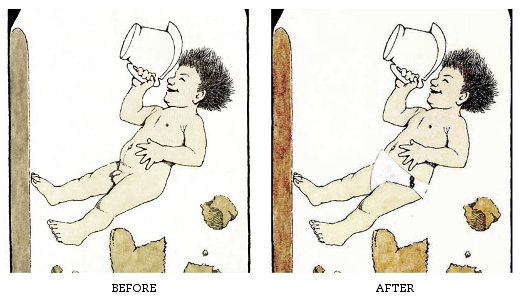
 I particularly remember the flap over In the Night Kitchen by Maurice Sendak which has a drawing of a naked little boy. Published in 1972, the book engendered intense discussions in my graduate classes in library school. Some librarians chose to draw diapers on the little boy; some chose to remove the book from their library. As I was watching the CleanFlicks documentary, I was reminded of those teachers who chose to draw the diapers. Because of Maurice Sendak’s reputation, they didn’t feel confident about not having the book in the library, but they still didn’t want to have that naked little boy on their shelves. I had the book on my library shelf my entire career and never once entertained any objection.

Another time, a teacher came to me after he had started reading Tom Sawyer to his class. “What should I do?” he asked. He had never read it before and didn’t know that one of the characters was named “Nigger Joe”. Should he change the name of the character? I suggested that a simple explanation to the students that calling someone Nigger Joe was how slaves or freed slaves were addressed 100 years ago. It would be a good history lesson. A publishing house has recently decided to sanitize Tom Sawyer and Huckleberry Finn by removing all the references to “nigger” and “injun” from the books—Mark Twain for the politically correct century, I guess.

 And then, recently I was involved with a group of librarians, scholars, and booksellers who were creating a list of the best books for children. One of the decisions we had to face was to decide whether we would include the “Little House” books on our final list because Pa Ingalls calls the Native Americans “injuns”. Believe me, there was a lot of intense debate over that! Practically every member of the committee had loved the “Little House” books and couldn’t image any list of “best” books without them. Would we remove “injun” from future editions of the book? Would we put a disclaimer on the book list? In the end, we decided to leave the books as is, thank God.

 Children are so smart. If they are told why African Americans were called “niggers” or Native Americans were called “injuns” in these well-loved books, they are most likely to go “Oh, OK” and settle down to listen to, or read, great literature. They don’t need diapers on naked little boys, or black magic markers through offensive words. 

Philip Nel, a professor at the University of Kansas wrote an outstanding piece on his blog about censorship of children's books. He spoke extensively about the Oompa Loompas in Charlie and the Chocolate Factory. In early editions they were African Pygmies, but in later editions White. In early editions they came from Africa, in later editions they came from Oompa  Loompa Land. I had to chuckle about this because my toddler granddaughter's favorite song of late is Oompa Loompa from the Charlie and the Chocolate Factory Movie. 

Nel closes his blog posting with these comments:  "As a negative state, innocence cannot be sustained indefinitely.  As they grow up, children will gain experience and knowledge.  Some of those experiences will hurt; some of that knowledge will make them sad.  If we exclude troubling works from the discussion, then children are more likely to face sadness and pain on their own.  It is, I think, better that we give them the tools with which to face prejudice-bearing literature.  In doing so, we can help them learn to cope with a world that can be neither just nor fair.  With this knowledge, perhaps we may also give them a source of power."


You might also be interested in the article I wrote for Banned Book Week last year. You can find it here.
          
 An interesting analysis of the Cleanflix documentary by a Mormon: http://www.withoutend.org/cleanflix-documentary/

Monday, September 26, 2011

In Honor of Banned Book Week: My Experience with Scary Stories to Tell in the Dark

Librarians are the primary champions of the right to read in the United States. Because I spent most of my career as a children’s librarian, my support of the right to read was primarily cerebral, but about half way through my career, there was a movement to question the books in our library. The first challenges came from an area church in the form of a list. Our first inclination that this was happening came when a parent helper arrived with a list one day and began to make a pile of books that had witches in them, including Strega Nona by Tomie dePaolo, Hansel and Gretel, and other fairy tale books. She told us that these were evil books and shouldn’t be in our library.

This particular challenge burned out rather quickly; the parents just made their wishes known, and I told them that if they didn’t want their children reading books with witches in them, they needed to tell them not to pick those books. I had no intention of removing classic children’s literature from our library.

Several years later, I experienced the only real challenge of my entire career. A third grader checked out Scary Stories to Tell in the Dark by Alvin Schwartz. This is a retelling of several urban legends and old scary tales. Included in the book is the old story about the couple who are parked in a recreation area parking lot when they hear a report on the radio that a madman with a hook for a hand has escaped from the asylum. Scared, they quickly start their car and leave. When they get home, they discover a bloody hook attached to their car door handle. Of course it is a cautionary tale, and certainly one that I had heard as a kid. The drawings by Stephen Gammell are without a doubt the scariest part of the book. The book is classified as non-fiction because Schwartz researched and documented each story from the region of the country from which they arose. Was it an appropriate book for a third grade girl? Probably not, but it was perfectly appropriate for an elementary school library because of its classification as a well-researched set of folk tales. 

Well, the mother of the third grader approached the school board president and the superintendent. The first I heard of it was when the superintendent came to me and asked me to remove the book from the library to avoid a stink at the school board. I told him I would have to get back to him, but I would appreciate it if he would read the book before he made a decision about it. (Neither he nor the school board president read the book, I might add.)

In the meantime, I contacted the American Library Association. They sent me a huge pile of papers to read and told me that Scary Stories to Tell in the Dark was one of the decade’s most challenged books. At that point, I was armed for battle. I had to decide if I was ready to be fired over a children’s book. For heaven’s sake, it wasn’t even Catch 22 or Huckleberry Finn!

The superintendent came to me again, took me into the back room of the library and tried to reason with me. He told me that there were thousands of books in my library; why would I risk my career over one book. I told him that this was a book that could face down a challenge because of its provenance, and that I was willing to defend it.

Well, the gods intervened. Halloween came. On the morning of Halloween, the principal came screeching into the library. “Miriam, you have got to see this!” I ran out into the hall to see the mother who was challenging the book arriving at school with her kindergarten daughter and her third grader. The kindergartener was dressed like a witch, the third grader was dressed like a skeleton, and they both were carrying ghost balloons. We took pictures of both children as part of the day’s activities, and later the superintendent suggested to the mother that perhaps she had better withdraw her challenge.

A crisis averted. When I retired, the Scary Stories book was still in the library as were the Strega Nona books and the fairy tales. I continue to believe that one way that children learn to cope with a hostile world is to read widely.  I also maintain that if parents check their child’s book bag and find books from the library that they don’t want their child to read, it is their responsibility to censor their child’s reading. It is not the library’s responsibility. 

Last year I reviewed This Book Is Overdue by Marilyn Johnson. It is the study of modern librarians. She has a marvelous chapter in the book about censorship and four librarians who challenged the Patriot Act. Well worth reading.